
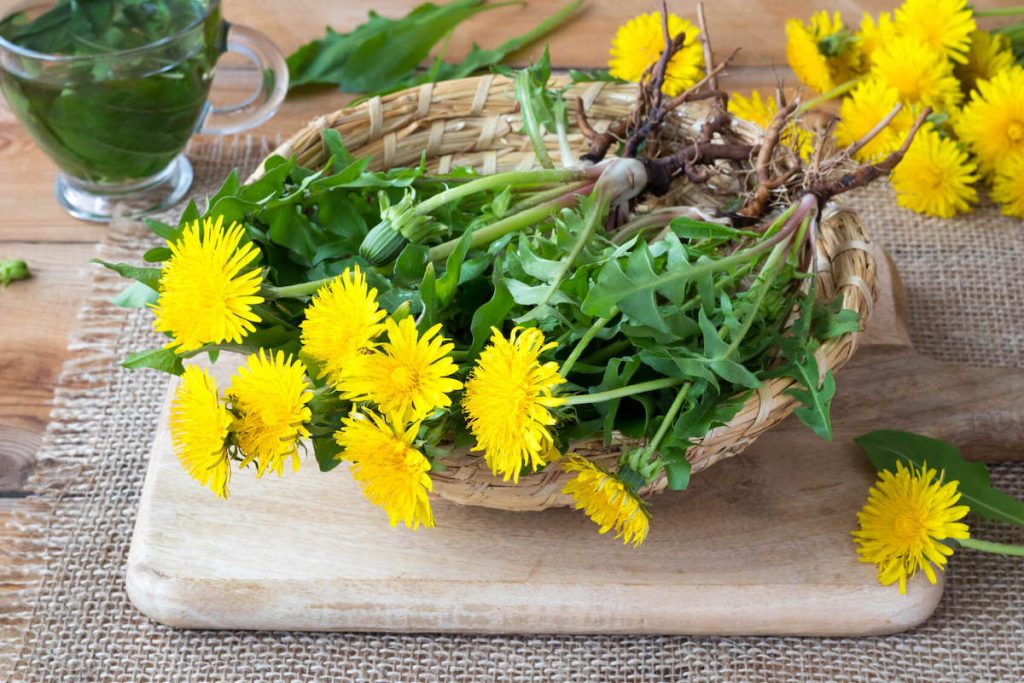
People spray their lawns to get rid of it, while others use it to heal their body of numerous ailments. What could it be? Well, dandelions of course!
Whether your eat or juice the greens, indulge in the honey-flavoured flowers or steep some dandelion root tea, this herb is pure magic!
The health benefits of dandelion include bone and skin health, help with liver and urinary disorders, acne, jaundice, diabetes, cancer and anemia.
The only problem is, is that most people are killing the very plant that could be helping them. Dandelions are not a pesky weed, and should be utilized to their full advantage!
Dandelions Are Not Weeds
Only in the twentieth century did humans decide that the dandelion was a weed. Before the invention of perfectly manicured lawns, dandelions were more less praised as a natural medicine, food source and out-right magic. Back in the day, grass was dug out to make room for the dandelions – just imagine!
According to the Maine Organic Farmers and Gardeners Association, “The use of dandelions in the healing arts goes so far back that tracing its history is like trying to catch a dandelion seed as it floats over the grass. For millennia, dandelion tonics have been used to help the body’s filter, the liver, remove toxins from the bloodstream. In olden times, dandelions were prescribed for every ailment from warts to the plague. To this day, herbalists hail the dandelion as the perfect plant medicine: It is a gentle diuretic that provides nutrients and helps the digestive system function at peak efficiency.”
Dandelions are also good for your lawn. Their roots break through hard-packed soil to help aerate the earth and help reduce erosion. Their deep taproots pull up calcium and other nutrients from the depths of the soil, making them available to other plants. These nutrients actually help fertilize the soil, improving the quality of grass and other surrounding plants.
The less we focus on dandelion as being a “weed”, the more we can appreciate what this plant truly is – a natural medicine that can actually help treat many ailments we see today.
Top 10 Health Benefits of Dandelion
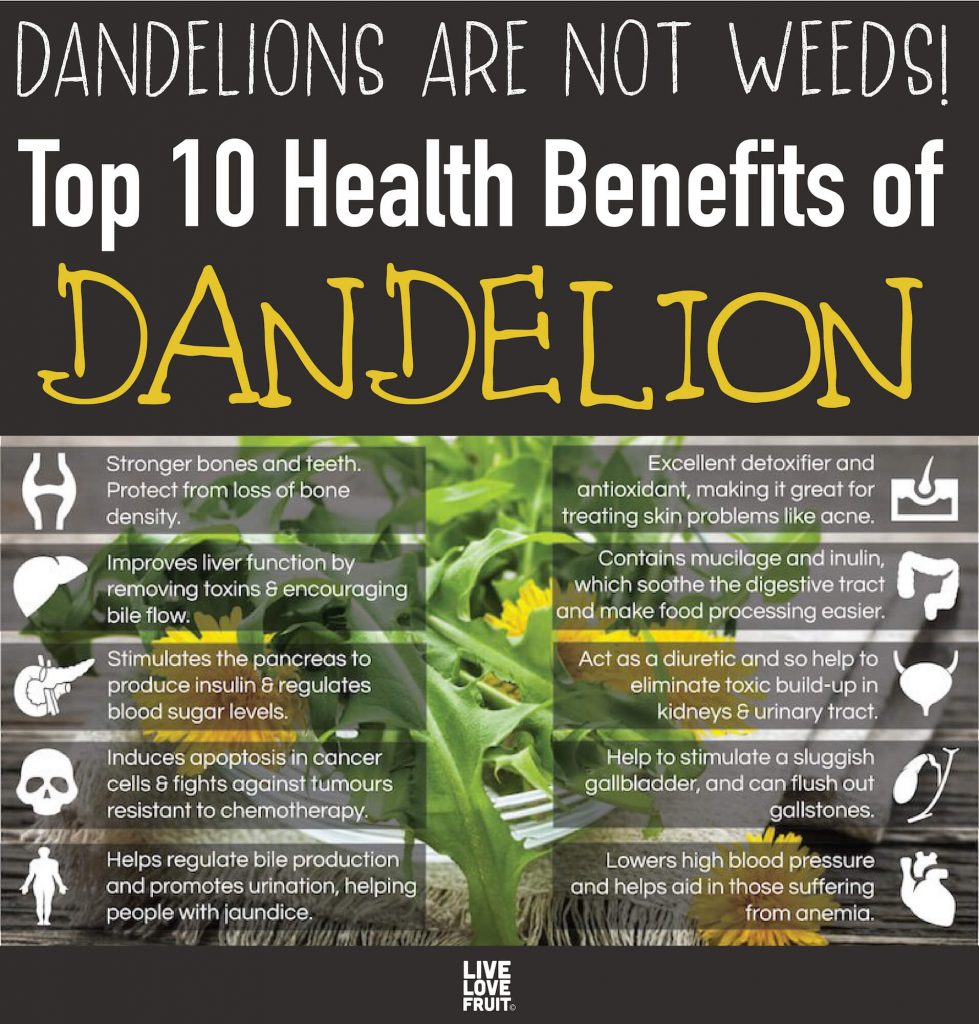
Dandelions are a green and growing first aid kit! Their ability to heal and nourish the body from the inside out make them one plant you definitely do not want to get rid of this summer. There’s a reason dried dandelion root is so expensive.
If you don’t have access to dandelion or can’t find any clean sources (steer clear of dandelion from sprayed lawns), you can always order your own dandelion seeds and grow them yourself!
Here are 10 of the most important health benefits of dandelion:
Stronger Bones
Dandelions are calcium-rich, which is the main element required for the growth of strong, healthy bones. They are also high in antioxidants like Luteolin and Vitamin C, which protect from loss of bone density and bone weakening (1).
Liver Health
One of the greatest benefits of dandelion is how it nourishing and healing the liver. Dandelion has been shown to improve hepatic function by detoxifying the liver and reestablishing hydration and electrolyte balance. It also increases the production and release of bile. One of the greatest benefits of dandelion is it’s effect on our liver.
A laboratory study on mice showed this medicinal plant’s ability to slow down the progress of carbon tetrachloride-induced liver fibrosis or scarring.
Diabetes
Dandelion helps stimulate the pancreas to produce insulin, and helps regulate blood sugar levels. It is also a natural diuretic, and thus encourages urination. What does this have to do with diabetes? It helps remove excess sugar and salt from the body, and reduces sugar build-up in the kidneys (thus helping reduce the risk of renal problems in diabetics) (3).
Urinary Health
As mentioned above, dandelions are a great natural diuretic, and so they help eliminate toxic build-up in the kidneys and urinary tract. The anti-microbial properties of dandelion also prevent bacterial growth in the urinary system, which is great for individuals suffering from recurring urinary tract infections (UTIs) (4).
Better Skin
Dandelion is an excellent detoxifier and antioxidant, making it one of the best herbal remedies for treating acne and other skin problems like psoriasis and eczema. It helps purify the blood, and improves liver function, both of which result in beautiful, glowing skin. The major chlorophyll content in dandelion greens is also a win-win for skin health.
Cancer
Another important use for dandelion is its powerful effects against cancer. Many studies have found that dandelion root extract is effective in the treatment against leukaemia and breast cancer. It acts by inducing apoptosis in leukaemia cells, while leaving healthy cells alone. It also has a positive impact against cancer cells that are resistant to chemotherapy.
A 2011 Canadian study found skin cancer cells treated with dandelion root extract started dying off within just 48 hours of treatment. Dandelion root has also been shown to be effective against pancreatic cancer and prostate cancer.
Jaundice
Thanks to the liver-healing abilities of dandelion, it also helps with jaundice, a disorder of the liver, where it overproduces bile and messes with the body’s metabolism. Dandelion helps regulate bile production, and also promotes urination, helping to get rid of excess bile (5).
Gall Bladder Disorders
Dandelion leaf is great for stimulating a sluggish gallbladder (the organ that stores and excretes bile as the body needs it). Gallstones can even be flushed out by using a combination of dandelion and milk thistle.
Digestive Issues
Dandelion contains mucilage and inulin (6), which soothe the digestive tract and make food processing easier. It is also a great source of dietary fibre, which is crucial for proper intestinal health and improving gut flora. If you suffer from constipation or diarrhea, eat some dandelion greens!
Circulatory Health
The high levels of iron, B-vitamins and protein in dandelion make it a perfect food to eat if you suffer from anemia or other blood-related disorders. Dandelion is also a natural diuretic, so it helps lower blood pressure by getting rid of excess salt in the body. The fibre in dandelion is also helpful in reducing cholesterol, which we all know is an integral part of maintaining a healthy circulatory system.
Picking & Processing Dandelion
Picking and processing your own dandelion might be an option if you have a yard with plenty of the plants. If you don’t have any dandelion in your yard currently, you can purchase dandelion seeds online to grow your own dandelion patch.
The entire dandelion plant is edible: flower, leaves and roots. It has a taste that resembles that of a spicier arugula. If you plant to harvest your own dandelion, make sure you harvest from an area that is not treated with chemicals or fertilizer of any kind. Avoid areas near freeways or public parks.
Some grocery stores even sell dandelion greens if you’re not up to foraging.
If you do plan on harvesting your own dandelion, the best time to do it is in the spring when they are young (before they flower) and again in the fall.
When it comes to harvesting, you want to try to pick the youngest leaves, which will be located on the inside of the growth. The oldest (and bitterest) leaves will always be on the outside. The best greens from the dandelion plant often come before the plant has produced its yellow flowers.
To harvest the leaves, all you need to do is pluck them out of the ground and collect them in a basket, bowl or bag. They’ll keep for a couple days in the fridge, but the fresher, the better (so try to eat them as soon as you pick them!).
Dandelion Crowns
Dandelion crowns are the densely packed circle of small leaves that are just about to produce a yellow flower. The crowns are the best tasting part of the plant (and the sweetest). Pick them if you can, before the plant has had a chance to flower. Dandelion crowns can be stored in the fridge for a couple days, or dehydrated for 1-2 days at 115ºF in a dehydrator (and then stored in a mason jar).
Dandelion Flowers
To harvest dandelion flower, pluck them off the green stem. Try to separate the flower from the green base, which can be quite bitter. You can store the flowers in the fridge for a couple days, or you can dehydrate them in a dehydrator at 115ºF for 1-2 days until they are completely dried out. Once dried, you can store in a mason jar and make tea with them throughout the winter months.
Dandelion Leaves
To harvest dandelion leaves, just pluck off the greens from the stem. Remember, the best tender greens are those that grow nearest to the stem. The larger outer leaves will be much more bitter (but they are still beneficial if you can handle the bitterness!). The leaves will store in the fridge for a day or two, but it is best to use them right away. You can also dry the leaves in a dehydrator at 115ºF for about 8-15 hours (or until crispy and dried). Once crisp, transfer to a mason jar and store in the cupboard to make tea.
Dandelion Root
Harvesting dandelion root can be a pain in the butt, but it is so worth it. The best time to harvest dandelion root is in the spring, since this is where all the vitamins and minerals are stored during the cold winter months. You can use a weeding tool to dig at the base of the root and pull up. Otherwise, you will just have to dig with a spoon or other tool to dislodge the hearty tuber from the ground. Once you’ve harvested the root, clean and scrub them thoroughly in the sink, and chop them into pieces, just as you would a carrot. You can use the root directly as is for boiling down into tea, or you can dehydrate them at 115ºF for 1-2 days, until completely dried out. Then, you can store the root for use over the winter as tea.
If you are not interested in picking and processing your own dandelion, or don’t have access, here are some products you can utilize in your home to gain full benefits from the plant. Since these products come from other companies, use their instructions on their products on how much to consume. As always, I will only ever link products here that I would personally use myself:
– Organic Dandelion Leaf & Root Tea
– Organic Raw Dandelion Root Tea
– Organic Dandelion Tincture (whole plant)
– Organic Raw Dandelion Root (to make your own tea or tincture)
How to Use Dandelion
Dandelion can be utilized in all its forms. Whether you want to use the flower and leafy greens in your salad, or steep a body-warming tea with the root, you can receive so many benefits from the plant!
Dandelion Crowns & Flowers
Dandelion crowns and flowers can be consumed fresh on top of salads, or straight up as a snack. There are also many different applications for using the crowns and flowers as outlined below:
- Dandelion Flower Infused Oil
This oil can be used to heal chapped or cracked skin, and is also useful to soothe sore muscles and other aches and pains. The shelf life of the oil is about 1 year.
To make it, fill canning jar about half-way with dried dandelion flowers. You can dry the dandelion flowers in a dehydrator at 115ªF for about 1 day (or until completely dry).
Once the flowers are in the jar, cover them with about twice as much as your favorite carrier oil (olive, sweet almond, apricot kernel, avocado and hemp oil are my favorites). Cap the jar, and place in a dark cabinet for 4-6 weeks, shaking occasionally as you remember.
Once the infusion time has passed, strain the dandelion flowers from the oil into another canning jar, and store in the fridge for up to 1 year. - Dandelion Flower Salad
Young dandelion petals have a honey-like flavor; mature blossoms are bitter, but still nutritious and pretty. You can consume fresh dandelion flowers on top of your salad if you want to reap the benefits of the raw flower. Simply cut off the green stem at the base of the flower (the bitter part), and toss in whatever salad you’re making.
You can also use dandelion flowers as garnish in desserts. The bright yellow hues make them the perfect option for livening up desserts of any type.
Dandelion Leaves
Dandelion greens are the bitter part of the plant, meaning they’re great for increasing production and release of bile in the liver. They can be eaten raw in salads, juiced, or even made into vinegar!
- Dandelion Vinegar
To make dandelion vinegar, harvest the leaves, stems and flowers from a fresh dandelion plant. Rinse them well, and fill a jar full with the plants (don’t pack too tightly). Next, pour apple cider vinegar over the fresh plants until the jar is filled. Cover the top of the jar with wax paper or plastic wrap, and then screw on the lid (to prevent the acid of the vinegar from eating away at the metal on the lid). Place the jar in a dark cabinet and store for 4-6 weeks, shaking occasionally. Once the infusion is done brewing, strain and store in another jar. It is now ready to use!
You can use dandelion vinegar on your salads by combining it with some olive or hemp oil and some maple syrup and salt to taste.
Another use of dandelion vinegar is using it as a spot-dabber on itchy bug bites.
You can also use dandelion vinegar as a diluted hair rinse. Dilute 1/4 cup dandelion vinegar with 1/4 cup water, and rinse your hair with it to produce silky soft locks. - Dandelion Juice Shots
Dandelion juice made from the raw plant is incredibly healing for the liver, and other organ systems of the body.
To make, all you need is a juicer, and dandelion leaves that are freshly harvested. Run the dandelion leaves through the juicer to make 1-2 shots of fresh dandelion juice. I personally like to just take a shot, because it is so bitter, but some people like to make juice combinations with dandelion like adding in some apple, lemon and ginger (for about 3-4 cups of dandelion greens, add 1 apple, 1/2 peeled lemon and a thumb-sized piece of ginger). - Dandelion Salad
Harvesting fresh, young dandelion greens and adding them to a salad of mixed baby greens is a great way to incorporate these plants into your diet!
Dandelion Root
Dandelion root can be used to make a medicinal tea for treating digestive issues, gallstones, inflammation, muscle aches, and bloating. It can also be roasted into a concoction that works as a great coffee replacement. There is so much you can do with dandelion root. Here are some of my suggestions:
- Dandelion Root Tea
Once you have harvested your dandelion root as outlined above under “preparation”, you will want to boil down the dandelion root in water to release all the beneficial nutrients.
Bring 4 cups of water to a boil in a pot, and add 1/4 cup dehydrated dandelion root. Reduce the heat to simmer, and put a lid on the pot. Let simmer for about 30 minutes, and then take off the heat to let sit and cool.
You can drink the tea as is, or add your favorite sweetener (maple syrup with dandelion is an amazin combination!). Depending on your stove and how hot the water was boiling and simmering, you might get more or less yield at the end. Drinking about one cup every day should suffice. If you have any extras left over, store in a mason jar in the fridge, and heat up the next day to consume. - Dandelion Root “Coffee”
If you are looking for a replacement for coffee, look no further! Roasted dandelion root tastes very similar to coffee, and many people have used it to kick their caffeine addiction. There is even a company out there that sells a “Dandy Blend” as an alternative to coffee drinking!
Using fresh dandelion root that has been cleaned and cut into cubes, roast at 400ºF for about 30 minutes until they’re completely dry and brown, but not burned. If your oven tends to run a bit hot, set the oven to 350 degrees and roast them for 40 minutes. They should come out dry and toasted, but not burned.
You can either take the roasted root and steep it into a tea, or you can grind down the roasted root to make into a powder similar to coffee. You can then take this powder, and utilize it as you would coffee in your coffee pot or french press.
Serve the dandelion coffee with coconut cream and a sweetener.
Whole Dandelion Plant
You can utilize the whole dandelion plant in things like tinctures where you can provide your body with the benefits of the whole plant all year long.
- Dandelion Tincture
To make a dandelion tincture, harvest an entire dandelion plant and wash each part very well. Once you’re done, chop the entire plant as finely as you can. You’ll want about 3-4 cups of fresh plant cut up.
Place the pieces of the freshly cut plant in a mason jar (jar size depends on how much plant you’ve gathered up) then cover with an 80 proof or higher alcohol like vodka. Make sure you cover the lid with plastic wrap or wax paper before securing the lid, as the alcohol can eat away at the metal lid as it sits.
Cap the jar and store in a cool dark place for 2 to 3 weeks, shaking occassionally. Once it has finished sitting, strain into a clean mason jar or pour into individual tincture bottles with droppers.
Traditional herbalists recommend a dosage of up to 30 to 40 drops, three or four times per day, but since tinctures are quite powerful, I recommend taking no more than 5-8 drops a day. Use this tincture to help with constipation or a sluggish liver that leads to poor digestion and acne.
There are so many ways you can enjoy the benefits of dandelions. What are some ways you’ve utilized dandelion in your life? Let me know in the comments below!




I have read about all the ways dandelion during WW2. I am very interested in trying some of them.
I make dandelion root and hibiscus flowers and ginger root tea for ICE tea
Yummy!
Thought this article was very informative. I had no idea there were so many uses for dandelion leaves!
Thanks for sharing.
Thanks Danice! Isn’t it cool that the very plants most people view as weeds are actually helpful medicines?
I had a veterinarian who was a bird specialist tell me to feed un-sprayed dandelions to my parrot; along with pound cake for iron, and fresh fruits and veggies as well as his seeds. I was also told to put something into the cage to give my bird some privacy. My parrot loved the food upgrades and hideouts, and he became much calmer. <3 I wonder if I can hide dandelions in my families salad. The things a mom has to do.
Yess ooo
I would love to know more.. Im baffled by this……
Since I was a child and even more so now I have allergies 365 days a yr and have to take 20mg of Reactin every day. Grass to pollen and Milkweed plants including Dandelions. Not everyone can eat it and if I am so allergic to it, why would it be safe to eat????
If you are allergic to dandelion, then yes, you should probably stay away from it.
Carly, I have been diagnosed with type 2 diabetes and am having trouble lowering my blood sugar levels below 300. I take Metformin and a few others that are supposed to help, but I was reading an article that said insulin resistance is caused more by “Fatty Liver” than diet. When you say dandelions help the liver in purging toxins, has your research, or any research, found that fat build up is one of those toxins or does this just apply to other toxins ? If so is such research findings confirmed by any other clinical study ?
Hello! This study (https://www.ncbi.nlm.nih.gov/pubmed/23603008) found that dandelion leaf extract alleviated high-fat diet-induced nonalcoholic fatty liver in mice. Take from it what you will. If you are interested, I have an entire article on how to get rid of type 2 diabetes: https://livelovefruit.com/10-steps-reverse-diabetes-naturally/
Another plant that is great, and NOT a weed is purslane. It’s everywhere.
You bet! That’s another great one 🙂
What is purslane?
& Carley is the whole plant safe to eat including the stem raw or should it all be boiled, baked, sautéed, juiced, all including the stem ??
Purslane is like a succulent, but one you can eat! Super high in silica for the hair, skin and nails. Look up “purslane” on google for an image of what it looks like – you’ve probably seen it in your garden!
You should avoid the stem as it contains too much of the milky white substance. Just go for the root, flowers and leafy greens.
Very INFORMATIVE
Amen. With every symptoms from diabetes to bad skin I’m going to invest in this medical plant to reduce the medicines from killing my liver. Can’t wait to share this with my doctor. This has been so informative.
Wow… We just use it for flowering, now I know that it has a lot of benefits. So inspiring, thank you.
By the way As I know there are some different color of dendalion’s flower. Can qe use any one to consume?
You showed a yellow one color
Yes, the dandelion I am talking about in this article is the common dandelion or Taraxacum officinale.
Are the dandeline stems edible ?
I’d probably just stick to the leaf, flowers and root as the dandelion stem contains a thick milky white substance that won’t taste the best, and could upset the stomach.
Yes dandelion is very good. I get the leaves every morning, clean it with salty water, cleanse again and chew it like that. Over here in Ghana, we don’t plant them, it just grow by itself.
Great info. Can dandelion capsules from the health food store do the same for your health
Fresh is best, but capsule form is also useful if you can’t find any fresh dandelion.
Thanks for sharing the useful information about Dandelions. I have diabetes, rheumatoid Athritis, Crohns, Beta Thelsemiac, Cancer in Remission…… All these could be solved with just Dandelions… I can’t believe my eyes. I am currently on 9 Tablets plus 2x 12 units insulin every day. I will discuss this with my GP and 5 Specialists how to go about with this.
Thanks so much
THANKS FOR THIS INFO WILLIAM
I had dandelion tea…
Great information. Had no idea also that dandelions are so health for you.I’m a tea drinker and I needed this tea a long time aga.Great info now I have to get my dandelion tea?
I learned the benefits of dandelions and would picked them from an Asian market to add them into my smoothie drinks. However every time I consumed it, my ten toes at night would develop inflammation, heat and itchiness to the level of uncontrollably uncomfortable.
Could I be allergic to it?
Or could I paired it with any particular veggies (in my green juices/smoothies) that caused adverse reactions?
Otherwise I love that this plant can do so much goodness for our health and wish that I can consume it freely.
Weird, I have never heard of anything like that. Make sure the greens you buy are organic. Asian food stores often do not carry organic produce.
Was it bitter?
Grandmother put the bulb, which is just above the root, in potato salad. Cut just about an inch and a half off and clean it. If there is a small flower forming cut it up in the potato salad also. It is very crunchy like onion but really has no flavor. Why do I mess with it? Because Grandma did. Maybe she knew something I didn’t, like it was good for us.
Hi there, Carly! I actually have a recipe for a dandelion jam that I haven’t made yet but I will. I found the recipe in a book that belongs to my nan. I believe that you can make anything out of any wild natural plants .
Interesting never knew dandelions did all that
HUH
Very informative! Thank you! Definitely sharing! Funny story, my dad used to take me and my two younger brothers as kids to a field of dandelions and made a game out of picking them. As I got older I realized he was making wine. ???
Haha, I’ve heard that dandelion wine is quite good!
what did it taste like?
when I was a child (over 60 years ago) I would pick those pretty yellow flowers for my Mom . the smile on her face was very “healing” indeed. Now I leave them for the honey bees because it is the first flower of spring 🙂
How was it?
Carly,
Thank you for a very informative article on the dandelion plant; I would love to get more info on how to use and process it.
I have type 2 diabetes. How would I use the dandelion to help with this?
Drink dandelion root tea every day, or juice the greens on the regular (or include in salads).
Wow this is unbelievable. I want to learn more.