
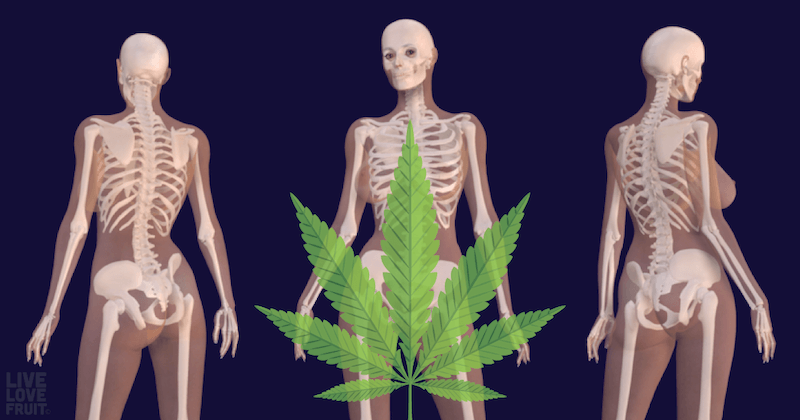
When most people think of cannabis, they don’t exactly picture stronger bones. But emerging research is turning that assumption on its head, especially when it comes to CBD, the non-psychoactive compound in cannabis that’s been making waves in natural medicine circles.
From easing chronic pain to reducing inflammation, CBD has already earned its place in many wellness routines. Now, scientists are uncovering an unexpected new benefit: it might actually help bones heal faster, grow stronger, and resist future fractures.
A team of researchers from Tel Aviv University and the Hebrew University of Jerusalem recently published a study with some pretty wild implications, especially if you’re dealing with osteoporosis, recovering from a fracture, or just want to support long-term skeletal health naturally.
Here’s what the science says about CBD for bone healing, and why this cannabis compound might be a game-changer for your bones.
What Is CBD?
The cannabis plant contains over 85 known chemical compounds called cannabinoids. The most popular is tetrahydrocannabinol (THC), the compound that is credited for getting someone “high” when they smoke or consume marijuana.
However, another cannabinoid that is quickly gaining popularity amongst those that would rather not get high is cannabidol, or CBD. CBD has been studied for many different medical applications, particularly its role in pain management. It has also been used for anxiety relief, nausea control, neuroprotection, seizure reduction, immune system support, psoriasis treatment, and more.
CBD and Bone Health: What the Science Says About This Cannabis Compound
According to a study conducted by researchers from Tel Aviv University and Hebrew University, a marijuana chemical known as cannabidiol (CBD) helps fractures heal faster and even makes bones stronger than they were before (1).
The study was published in the Journal of Bone and Mineral Research, and it’s the first time any data like this has even been published.
“We found that CBD alone makes bones stronger during healing, enhancing the maturation of the collagenous matrix, which provides the basis for new mineralization of bone tissue,” researcher Yankel Gabet said. “After being treated with CBD, the healed bone will be harder to break in the future.”
Do Bones Contain Cannabinoid Receptors?
The study published in the Journal of Bone and Mineral Research (mentioned above), found that rats injected with CBD alone (they injected rats with CBD, CBD+THC or nothing at all) was “sufficiently effective in enhancing fracture healing (2).”
The study supported the same team’s prior findings that the body contains receptors that respond to cannabinoid compounds, and that these receptors are not confined to the brain. Their prior studies found that the skeleton contains cannabinoid receptors that stimulate bone formation and inhibit bone loss. This new study confirms these findings.
The most common cannabinoid receptors in the body are CB1 and CB2 receptors. However, there is a third one that is just now getting noticed, the G-protein receptor, GPR55. This receptor is primarily found in the cerebellum, where it regulates muscle movement, blood pressure and bone density (3).
This receptor affects bone density by promoting osteoclast, which regulates bone re-absorption. An overactive GPR55 receptor can activate osteoclast cell behaviour, which transfers calcium from the bones and into the blood. If there is too much re-absorption, our bones become weak, and we are put at risk of bone diseases like osteoporosis. Activation of this receptor can also lead to other bone diseases like cancer (4).
CBD, however, works by inhibiting the GPR55 receptor, thereby improving bone density and reducing the occurrence of other bone diseases. It also helps strengthen the collagen “bridge” that forms at the site of the break, which then hardens into new bone.
Exactly what the study led by researchers at Tel Aviv University found.
Medical Marijuana Benefits Undeniable
This study is only one of many studies done on marijuana that prove just how beneficial it really is.
“The clinical potential of cannabinoid-related compounds is simply undeniable at this point,” Gabet said. “While there is still a lot of work to be done to develop appropriate therapies, it is clear that it is possible to detach a clinical therapy objective from the psychoactivity of cannabis. CBD, the principal agent in our study, is primarily anti-inflammatory and has no psychoactivity (5).”
As mentioned above, CBD has been studied with promising results for many medical interventions. It can be used for chronic pain, reduce the side effects of chemotherapy, as well as slow the progression of HIV. It is also being researched as a treatment for multiple sclerosis and Parkinson’s disease.
Unfortunately, despite the clear evidence, the Food and Drug Administration (FDA) still refuses to change their stance on marijuana as a Schedule I narcotic (yes, that means it is considered worse than meth and cocaine – pretty crazy, huh?). Keeping marijuana as a Schedule I drug, means that it will never be considered “medically applicable” (but meth and cocaine apparently are medically applicable, as they are scheduled under “Schedule II” — something doesn’t add up here!).
Research will continue to be limited in human subjects as long as marijuana remains a Schedule I drug. This means “sufficient evidence” will be nearly impossible to come by when it comes to finding solid research on this medical miracle.
How CBD Helps Fractures Heal
Bone healing is a multi-phase process involving:
- Inflammation
- Soft callus formation (mainly collagen)
- Hard callus formation (mineralization of collagen)
- Bone remodeling
CBD appears to improve the quality of collagen during early healing stages and enhances the speed and strength of mineralization. Essentially, it makes the “bridge” that connects the broken bone ends stronger and faster to form, which translates into quicker recovery times and sturdier bone post-healing (6).
Who Could Benefit from CBD for Bone Health?
This isn’t just theoretical—it could be game-changing for several groups:
- Older adults with osteoporosis: CBD could prevent fractures or speed up healing in individuals with brittle bones.
- Athletes recovering from injuries: Many are already turning to CBD for pain relief and inflammation. The added bonus? Faster bone repair.
- Postmenopausal women: Estrogen decline accelerates bone loss. CBD might offer a non-hormonal way to support skeletal health.
- People with inflammatory bone conditions: Rheumatoid arthritis, cancer-related bone degradation, or bone loss from chronic steroid use could all potentially benefit from CBD’s modulatory effect.
Of course, more research, especially in humans, is still needed.
What About CBD Side Effects?
CBD is generally considered safe and well-tolerated. The World Health Organization (WHO) has stated that “CBD exhibits no effects indicative of any abuse or dependence potential” (7).
That said, some users may experience mild side effects like:
- Fatigue
- Diarrhea
- Changes in appetite or weight
- Interaction with liver enzymes or medications (especially blood thinners)
Always speak with a healthcare provider before starting any CBD regimen, especially if you’re on medications.
Roadblocks: Why Isn’t This Mainstream?
Despite promising research, CBD still faces regulatory, legal, and social obstacles.
In the United States, marijuana is classified as a Schedule I drug, meaning it’s deemed to have “no accepted medical use and a high potential for abuse.” That puts it in the same category as heroin, and stricter than methamphetamine and cocaine, which are Schedule II.
This ridiculous classification:
- Stifles research: Federal restrictions make it almost impossible to conduct large-scale, double-blind human trials in the U.S.
- Discourages doctors: Most physicians are not trained on cannabinoids, and fear of legal repercussions often keeps them from recommending CBD, even when it could help.
- Confuses consumers: With the market flooded with poorly regulated products, it’s hard for the average person to know what’s safe, effective, or legal.
Until cannabis is rescheduled (or descheduled altogether), we’ll continue to rely on animal studies and small international trials to understand its full medical potential.
So, Should You Take CBD for Bone Health?
If you’re recovering from a fracture, struggling with osteoporosis, or just want to support skeletal health naturally, CBD is absolutely worth exploring, with a few caveats:
- Look for third-party tested products to avoid contamination and ensure accurate labeling.
- Avoid THC-heavy blends if you want non-psychoactive effects or need to pass drug tests.
- Start low and go slow, ideally under the guidance of a health professional.
And be realistic: while CBD can support healing, it’s not a miracle cure. Diet, exercise, calcium/vitamin D status, hormone balance, and lifestyle choices all play major roles in bone health, too.
The Bottom Line
CBD may not get you high, but its potential to strengthen your bones, modulate inflammation, and support healing is becoming hard to ignore.
The Tel Aviv study is just one more piece of evidence suggesting that the future of medicine may very well lie in this ancient plant. It’s time our policies caught up with the science, and fast.




Interesting. For us agin chicks, this is good news. I have tried CBD and have enjoyed it for relieving pain. I am not interested in being high–just not my thing–nor am I interested in taking a presciption. So, CBD is a good answer for me. Do you have any recommendations on a CBD product?
I get my CBD from nelsonpotorium.ca as an oil (I live in Canada so it’s legal).
Passing this on.