

Approximately 350 million people worldwide have arthritis. Pretty shocking, given the fact that these statistics don’t even include the individuals who aren’t officially diagnosed.
So what can cannabis for arthritis achieve with a disease that most people take pain meds for? Well, quite a lot, actually. But first, we need to learn a little bit more about arthritis, and what it means for those who have it.
What is Arthritis?
Contrary to popular belief, arthritis isn’t just one single disease. It is essentially an informal way of referring to chronic inflammation, joint pain, or joint disease. In fact, there are more than 100 different types of arthritis, and anyone of any age, race and/or sex can experience them.
Types of arthritis can include:
– Back pain
– Bursitis
– Carpal Tunnel Syndrome
– Chronic Fatigue Syndrome
– Fibromyalgia
– Gout
– Inflammatory Bowel Disease
– Lupus
– Lyme Disease
– Pagets
– Scleroderma
– Spinal Stenosis
While arthritis is incredibly common, it still remains a very misunderstood disease. It is so broad, that its classification literally means “inflammation of one or more joints.” You could pretty much put that classification on just about any disease.
Arthritis symptoms may come and go, and they can be mild, moderate or severe. They may stay the same for years, but then progress and get worse over time. If neglected for long enough, arthritis can inflict irreparable damage over time, and result in long or short-term disability and inability to perform basic functions like walking or climbing stairs.
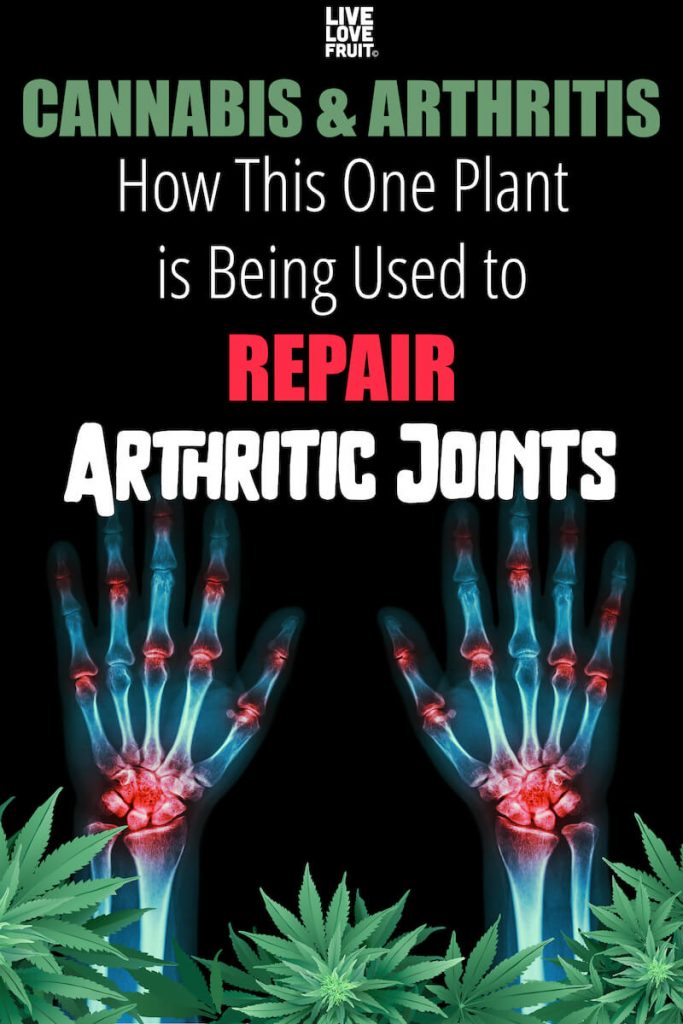
Arthritis likes to settle in weight-bearing joints like the hips, knees and spine, but it can also afflict non-weight-bearing joints such as those in the fingers.
Cannabis for Arthritis
Given that arthritis is an inflammatory condition, and cannabis beats inflammation, it is not that surprising that people are turning to cannabis for arthritis relief.
Within each and every one of us lays a system called the endocannabinoid system (ECS). The main receptors of this system are CB1 and CB2. CB1 receptors are mostly located in the nervous system, connective tissues, gonads, glands and organs. CB2 receptors take reign over the rest of our body, and are primarily found in the immune system. However, they’re also found in the spleen, liver, heart, kidneys, bones, blood vessels, lymph cells, endocrine glands, and reproductive organs (1).
Our body naturally produces endocannabinoids that stimulate and modulate these two receptors. Similarly, cannabis contains phytocannabinoids (like THC and CBD) that are closely related and molecularly similar to endocannabinoids. These phytocannabinoids also interact and modulate the CB1 and CB2 receptors, which produces a wide range of physiological effects.
A study published in the journal Rheumatology from Dr. Sheng-Ming Dai of China’s Second Military Medical University found that CB2 receptors are found in unusually high levels in the joint tissue of arthritis patients (2). This led the researchers to conclude that cannabis is key to activating those receptors, thus reducing pain and inflammation.
In 2008, a review concluded that CBD reduced pain associated with rheumatoid arthritis (3), and also improved sleep quality for patients without any negative side effects. Another study from 2017 found that CBD could be a safe and useful treatment for osteoarthritis joint pain (4).
Because cannabis is still illegal across much of America, and other countries, clinical studies carried out on actual human beings is lacking. This is slowly changing, however, as some countries, like Canada, have started legalizing the medicinal plant. As a result, more studies are taking place. In the meantime, we just need to wait (or simply trust how our own bodies feel when medicating with cannabis).
Repairing Damage to Arthritic Joints with Cannabis
Canadian researcher Dr. Jason McDougall, a professor of pharmacology and anesthesia at Dalhousie University in Halifax, has undertaken a new study to find out if medical marijuana can help repair arthritic joints and relieve pain. The study, supported by the Arthritis Society of Canada, was given a grant for a comprehensive, three-year study to investigate if cannabis repairs the joints by fighting inflammation, or if it is simply just dampening the pain response in the brain.
President and CEO of The Arthritis Society, Janice Yale, stated that (5):
People living with arthritis pain are looking for alternatives to improve their quality of life. We need research to help answer the many important questions about medical cannabis and its use. Our goal is to give Canadians the ability to make informed choices about their treatment options and to give physicians evidence-based guidelines to make treatment recommendations for their patients. This project is an important step to achieving those goals.
McDougall told CBC Radio’s Information Morning the following when asked to describe the nerves of an arthritis sufferer:
The nerves are like wires that have been stripped of their coating. They’re all bare, they’re all raw and responsible for feeling a lot of pain. What we hypothesize is that by locally administering these cannabis-like molecules to those nerves, we’d actually be able to repair them and reduce the pain of arthritis.
McDougall’s findings have so far shown that cannabis molecules can attach themselves to nerve receptors and control the firing of pain signals in the joint.
Another study published in the journal of Philosophical Transactions of the Royal Society B found that the body’s endocannabinoid system releases antioxidants that help repair damaged cells when it becomes triggered by outside cannabinoids (6).
The evidence seems compelling enough for anyone to trust that cannabis really does help those suffering from arthritic conditions. Some individuals have even gone as far as juicing raw cannabis to help alleviate their arthritis. The results? Inspiring to say the least.
Juicing Raw Cannabis for Arthritis
McDougall’s preliminary findings have actually been proven in some anecdotal circumstances. Take Katie Marsh from Maine, a sufferer of rheumatoid arthritis who was on prescription prednisone and antibiotics for years before she discovered cannabis. Her doctors encouraged her to take disease-modifying anti-rheumatic drugs (DMARDS), but the side effects were so intense that she finally decided to seek out the advice of a physician who specialized in dietary cannabis.
After speaking with the physician, Marsh began juicing raw cannabis and blending it into smoothies. She also consumed the whole plant, raw. The results she experienced were immediate. Within just a few days, Marsh went off prednisone and pain killers. After just 11 months of regular cannabis juicing, Marsh’s condition went into remission.
THC or CBD?
Cannabis contains both CBD and THC, but they differ from one another in that THC is psychoactive (gets you “high”), and CBD is non-psychoactive (doesn’t get you “high”).
As for which one works best with arthritis, both come with their own benefits. Both CBD and THC are useful for relieving inflammation in the body, but some people might prefer CBD as it doesn’t come with psychoactive effects.
CBD is particularly desirable for those with specific autoimmune conditions, as it works to enhance and improve the state of ones immune system.
CBD bonds best with CB2 receptors, making it easier to battle inflammation in the joints, whereas THC bonds best to CB1 receptors to give individuals relief from chronic pain. It is also good for anxiety and depression, two conditions that often plague the minds of those with debilitating conditions like arthritis. If choosing a THC strand of cannabis – go for indica over sativa, as it calms and relaxes the body more than stimulating the creative mind (that is, unless, you’re feeling a little creative).







How do I get it? How do I know it’s of GOOD quality like RSO??? I have medical marijuana card. Spent several dollars and months with little or no relief…
You really need to just try different brands to see what works best. If nothing is working for you, maybe try a higher dose?
Make sure you get a good pure oil, read the labels (there are some on the market that isn’t true CBD oil). It shouldn’t have more that 3 ingredients in it. Make sure it has documented testing. Do your research before just buying off a shelf. A good oil will be guaranteed
.I would Love to introduce you to the oil that I use, because after 5 days I was a 100% believer, as it has changed my life so much that I wanted to share it with everyone, so became an affiliate. It is so hard to believe that a few drops a day can make such a difference and give you a better quality of life. If I can answer any questions or concerns you may have please message me. To take a look at the product that has changed mine and so many other’s lives, visit our website by clicking here?www.johnniecbdoil.com
How can I get read of back n joint pains with cannabis weed, oil or juice. Is been a long time experience with joit pains
Just start taking more of it. I suggest CBD oil as it does not get you high – just helps with pain.
Classical homeopathy got rid of my mother’s crippling RA ( she had it for 20yrs) proof of her cure via blood test showing RA negative ?she is 83 takes no medication at all she has no pain no swelling
What did your mom take?
I tried homeopathy for RA and didn’t have any luck can you tell me what she used precisely where she went to be treated thank you
Does this work for psoriatic arthritis ? I have used the oil for neck and back pain..and it really helps.
It’d be worth a try to see if it helps!
I would also suggest anyone with these problems look into a plant based diet.
Agreed!
i am a dietitian and a cannabis educator, a yoga teacher and a tai chi practitioner . I will spread this information, thank you. I am a cannabis advocate and want to switch my career after 9 years of being a clinical dietitian .
Thanks so much! It needs to be spread! 🙂