
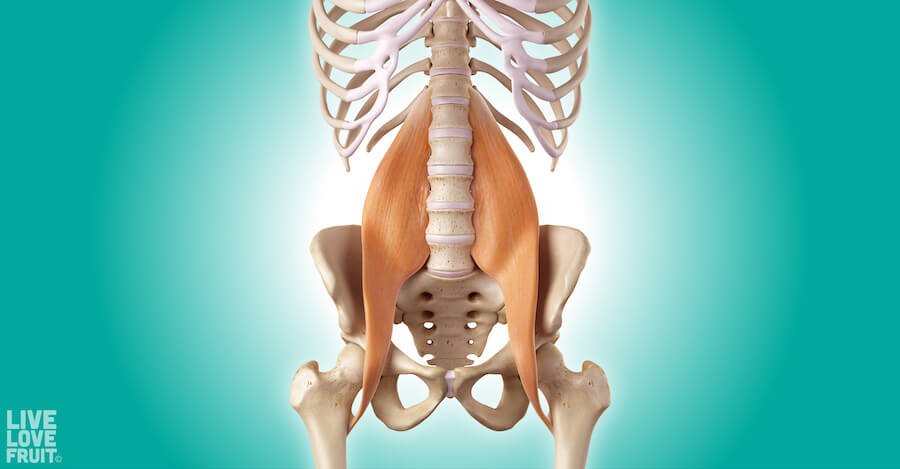
The psoas muscle is one of the most important muscles in your body. It lies deep within the centre of your core, connecting your femur to your lower back. While that might sound scary, the scarier thing is how it could potentially affect our mental state if it gets too locked up and tight.
Those seeking psoas muscle pain relief might not only feel more mobile in their hips and lower back, but they also might feel less fearful and anxious.
According to some, like therapist and filmmaker Danielle Prohom Olson, the psoas muscle (pronounced “so-as”) is like the “muscle of the soul,” and by relaxing it, you can reconnect to yourself, your body, and feel more balanced.
What is The Psoas?
The psoas muscle is the deepest muscle of the human body. It affects our structural balance, muscular integrity, flexibility, strength, range of motion, joint mobility, and organ functioning. In Greek, psoas literally means “muscle of loin”.
Three muscles are associated with what is commonly referred to as “the psoas”: the psoas major, psoas minor, and iliacus (1). As may already seem obvious, the psoas major is the larger of the two psoas muscles. The psoas minor is the smallest, and is absent in over half of the human population (could this muscle get any more strange?).
The psoas attaches from the 12th vertebrae, all the way down to the fourth and fifth lumbar vertebrae. It then continues down the sides of the spine (crossing many joints along the way), over the front of the pubic bone, and then attaches at the end, with the fibers of the iliacus, to the lesser trochanter of the femur (aka. the top of the femur, facing toward our inner thigh).
The entire muscle connects the upper half of the body to the lower half of the body – quite a feat for a muscle we barely hear about!
The psoas is also linked to the diaphragm through fascia (connective tissue), which impacts our fear reflex and breathing. This is because the psoas is directly linked to the reptilian brain, the most ancient inner part of the brain stem and spinal cord (2).
The Essential Role of the Psoas Muscle
Being able to stand upright is made possible by the curve in our lower spine, which transfers and bears the weight above it. The psoas muscle helps create this curve, as its attachment to the lower lumbar vertebrae helps pull these vertebrae both forward and down (3).
The psoas muscle also helps us walk. When walking, the brain sends signals down to the nerves that innervate the psoas muscle, telling it to move your back leg forward – initiating the back and forth leg movements that allow us to walk. So every time you take a step forward, you can thank your psoas muscle!
On the other hand, if you spend a lot of time sitting at a desk, driving, or repeatedly working these muscles in activities like bicycling, weight-training, or doing sit-ups, they can become short and tight (and painful). When the psoas becomes tight, it can pull the lower lumbar vertebrae forward and down toward the femur. This can result in lordosis (overarching of the lumbar spine), leading to low back pain, stiffness and pelvic pain.
The psoas muscle can also take on stress from our emotional body, similar to the way our shoulders can become tight after a traumatic or stressful situation. This is why many have referred to the psoas muscle as the ‘muscle of the soul’.
The ‘Muscle of the Soul’
The concept of the psoas muscle representing the ‘muscle of the soul’ is well described and analyzed by Liz Koch, an international teacher and author with over 40 years of experience working with and specializing in the psoas. Within the Taoist tradition, the psoas is spoken of as the seat or muscle of the soul, and surrounds the lower “Dan tien” a major energy center of the body (4).
Koch explains that “Long before the spoken word or the organizing capacity of the cortex developed, the reptilian brain, known for its survival instincts, maintained our essential core functioning.” She also describes that the “psoas literally embodies our deepest urge for survival, and more profoundly, our elemental desire to flourish.”
The connection of the psoas muscle to the diaphragm literally connect the acts of walking and breathing. There are two tendons for the diaphragm called the crura that extend down and connect to the spine right alongside where the psoas is attached (5). The diaphragm and psoas also connect through our fascia (as previously described).
If you think about it, when we’re stressed (aka. the less intense version of our primal fight or flight response), our breathing patterns start to change. Because the diaphragm is the muscle that directly controls our breathing, its connection to the psoas in turn affects the psoas. Depending on how we are feeling or what we’re doing, tightness or relaxation of the diaphragm will either create tension or relaxation in the psoas.
Therefore, feeling stressed will cause the psoas to hold tension, and the more stressed we become, the tighter it will get. When this muscle (or any muscle) remains tightened for too long, it will become shortened, creating a host of painful conditions like lower back pain, sciatica, and even digestive problems.
This can also work the other way around, too. If the psoas is chronically tight from sitting for long periods of time, or other triggering activities, it will affect our diaphragm and our breathing patterns. So we could literally become stressed and anxious due to fluctuating breathing patterns as a result of a tight psoas. Pretty crazy, huh?
According to Koch, “The psoas is so intimately involved in such basic physical and emotional reactions, that a chronically tightened psoas continually signals your body that you’re in danger, eventually exhausting the adrenal glands and depleting the immune system.”

Psoas Muscle Pain Relief: How To Stretch Out Your Psoas
If you want complete psoas muscle pain relief, then look no further. This series of different stretches will help unlock tightness in the psoas, and maybe even help you feel less anxious.
When you’re doing the following stretches, make sure you stay aware of what’s happening in your body and what you’re feeling. If you go into a stretch and it feels like sharp pain, ease back and don’t go as deep into the stretch. It is normal to feel a bit of pain when stretching, but it is the sharp pain you want to steer clear from.
As you spend time in each stretch, sense where your psoas is located, and feel (internally), whether it is tight or loose, rigid or soft, tense or at ease. Remember to breathe deep, too, as it is your breath that can help release deeply engrained tightness that might otherwise not want to let go.
1. Kneeling Lunge
1. Take a kneeling lung position on the ground with your front leg at a 90º angle in front of you.
2. Posteriorly tilt your pelvis (tuck your tailbone under, glutes tight), and shift your weight forward toward the front knee, while maintaining the posterior pelvic tilt.
3. Be sure not to curve the lower back – keep your tailbone tucked.
4. Stay here for 30 seconds to 1 minute. Relax, and then repeat on the other side.
5. Perform 3-5 repetitions on each leg.
2. Frog Pose
1. Beginning on all fours, bring your forearms to the floor. You can put a blanket under each knee for padding if you like.
2. Widen your knees, one at a time, as far apart as possible, and bend them so that your thighs and your shins are at 90-degree angles. Flex your feet.
3. Keep your front ribs in, your waist long, and your tailbone down.
4. Take 5-10 long, deep breaths. It will likely be very sore, but easing into this difficult pose only takes time and patience.
3. Psoas Release with Ball
1. For this exercise you will need a lacrosse ball, which can be purchased online, or at a sports therapy store.
2. Lay on your stomach and find the hip bone. Place the lacrosse ball toward your bellybutton, just a little bit lower than the hip bone (about 2 finger breadths).
3. Holding the ball here, slowly roll onto the floor, putting your weight onto the ball.
4. Hold this position for 20 seconds, or up to 8 breaths. You can also pivot on this muscle, and you will likely immediately find it to be quite tender. This should allow the psoas muscle to release.
5. Repeat on the other side. You can do this up to 3 times per day if you are not too tender.
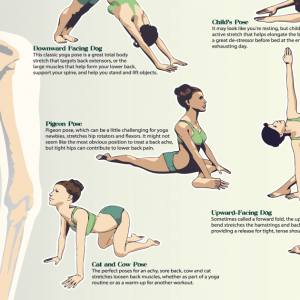
4. Pigeon Pose
1. Come into a kneeling position, and draw in your left knee. Turn it out to the left so that your left leg is bent and near-perpendicular to your right one. Lower both legs to the ground.
2. Keep your right back leg extended straight behind you, and stabilize yourself with your elbows on the ground, or if you feel comfortable, fold your upper body forward and collapse over the left leg to a fully relaxed position.
3. Stay in this position and hold for 5-10 deep breaths.
4. Switch to the other side and repeat.
5. Happy Baby Pose
1. Lay flat on your back and bend both knees, holding the outside edges of your flexed feet with your hands. Keep your arms on the outsides of your legs.
2. Use your upper body strength to press both knees to the floor below your armpits if you can. Don’t tense up your shoulders while doing this, try to keep everything relaxed and use gravity in your favour.
3. Stay here for 5 deep breaths, rest, and then repeat 2 more times.
6. Knees to Chest Pose
1. Start by lying on your back, with your arms and legs extended.
2. Slowly exhale and bring in both of your knees to your chest. Clasp your hands around them, or if you can, wrap your forearms over your shins and clasp each elbow with the opposite hand.
3. Keep your back flat on the mat and relax the shoulders. Tuck your chin in, and look down the center line of the body.
4. Hold for up to one minute, keeping your breathing deep and even.
5. Exhale, release and extend both legs on the floor. Repeat six times.
7. Garland Pose
1. In standing position, step your feet a little wider than shoulder-width apart.
2. Bend your knees and lower your hips, coming into a squat. Separate your thighs so they are a bit wider than your torso, but keep your feet as close together as possible. If your heels lift, support them with a folded blanket.
3. Drop your torso slightly forward, and bring your upper arms to the inside of your knees. Press your elbows against the inside of your knees to get a deeper stretch.
4. Lift and lengthen your torso, keeping your spine long and shoulders relaxed. Try to shift your weight into your heels to get an even deeper stretch.
5. Hold this position for five breaths, and then release. Repeat 3 times.




Hi Carly,
After traumatising my back age 12, I have experienced years of lower back ‘issues’ that have come in various forms from extreme pain, not being able to stand or walk, to weakness, twinges, an uneven pelvis and in more recent years extreme stiffness especially in the mornings; I need to bring my knees to my chest and hold for a couple of minutes before attempting to get out of bed. I am also unable to lie on a hard surface for any length of time without my back ‘siezing up’ and causing pain so am unable to do Shavasana. Who would have thought that lying down could be painful?!
An Osteopath recently mentioned this muscle and my curiosity has brought me here 🙂
Simultaneously a teacher mentioned Yin Yoga for the back (I see similar poses on this article) I’ve been doing a deep release Yin yoga routine (for a week or so now – early days) My back feels ‘twingy’ and delicate as though I have ‘awoken’ something.
My question is, if one has been carrying many years of tension and mechanical disfunction can deep stretching aggravate the condition and disrupt the status quo? Am I attempting to undo years of compensation and is there such a thing as too much? Any insights would really be appreciated. Would you also dare to say, in the case of a very tight psoas, whether chiropractic versus osteopathy treatments are more beneficial? And is there anything else I can try?
Many thanks in advance for reading my lengthy message.
Determined not to be an ‘old’ lady before my time!
Hey Karen! Ugh, yes, the body is such a mysterious thing. We hold soooo much trauma (both emotional and physical) in our muscles that sometimes it can be hard to release something (especially if it has built up over the years). I think the thing with stretching is to do it slowly, and do deep breathing while doing the stretches. Otherwise, you might injure yourself more. I think doing no stretching at all is not helpful. The key is slow, and breath. There is not a thing as too much, but if you’re new to stretching, I might say do 5-10 minutes one day, and increase to 10-20 the next. Hold each stretch until you feel the aching subside. Never push so far that you feel sharp pain. I would also highly recommend osteopathy (manual practitioner) over chiro, since they work more with everything, whereas chiro is more just bone. Another thing – Intramuscular Stimulation (IMS) if you can find a physiotherapist who does this in your area, would also be helpful. Myofascial massage/release is also a great healing modality.
Hi Carly. I appreciate you taking the time to reply and will look into your suggestions of IMS and Myofascial massage. Many thanks 🙂
No problem, Karen! I hope it works out for you, as it has for me 🙂
This is a God send! This is exactly what I am going through. I will try it so I can begin getting relief.
So glad the article can be of help 🙂
Hi carly my name is kuni Ramakatane from Lesotho in Southern Africa,
Everything you say is what am going through,
Though they say it is rheumatoid arthritis but am going for MRI tomorrow and am glad I came across the stretching exercises I will try them
Thank you .
Carly, any suggestions if you have painful knee issues & Baker cysts. Most of the exercizes require tight bending or presssure on or from the knee, and I just can’t…. also a misalignment of pubic seems related to the psoas problems for me – any suggestions?
Hey Carol – I have an article relating to knee exercises and stretches: https://livelovefruit.com/eliminate-knee-pain-10-strengthening-stretching-routine/ Maybe that would help?
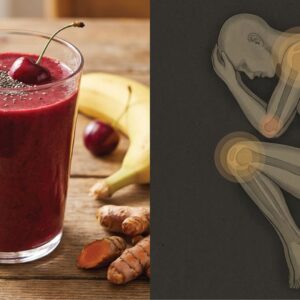
I think this might be my problem. Especially after looking at the drawings of the muscle. For quite awhile I have been experiencing a strange pain in what I thought was my right hip joint. If I walked too much after the pain started I would feel the sensation of my thigh muscle feeling tired. As time went on the time, and distance, I could walk before it was too painful got shorter. Then I started to feel a “knot” anytime I overdid physical labor until not too long ago when all I had to do was get out of bed. This painful knot is located just below where my kidney is located on the right. For about a week the knot has gotten so tight and painful I can barely walk. I never thought the two problems could be connected due to the distance between them, approximately the length of my hand. My common sense has been telling me I am doing the worst thing I could do by just sitting because the pain is slight to none. But my inner “baby” whines and says “I don’t want to move!”. I looked at your stretches and felt myself doing them and felt the relief they will bring. Thank you for the article and especially for the pictures showing where the muscle winds through the body. It was the pictures that piqued my interest and made the connection of my two problems. Even if it is not the Psoas the stretches are going to help. I have always been a proponent of stretching but have gotten lazy. My inner baby can just fuss. I’m starting tonight.
Hope they work Judy! It is such a pain to be in pain all the time!
Hi Carly,
I have been trying to find the real reason why: my leg from knee down is swollen, my foot is swollen so large it’s hard to walk, my knee hurts, probably the worst pain is in my groin, I have not experienced groin pain before it is agonizing, my thigh muscle towards my hip is very tight. The most frightening of this ordeal is that I can’t breathe, I am wheezing.
I went to my doctor and right away she focused on my lungs and said we’d look at my leg later. They placed my swollen foot up on a chair with a pillow, when the nurse lifted my leg straight up from the floor a sharp pain went through my groin, hurt so bad I screamed. All the walking to the Dr office had elevated the pain in my left leg. All of this is in my left leg. I noticed my right foot was starting to swell. The Dr ordered all the med tests, blood clots in lungs and leg and more. Dr prescribed an inhaler for my lungs along with antibiotics and water pills for my leg and a cream, requiring prescription, for my groin, knee and thigh. Muscle relaxers.
The medication has helped me with breathing and the swelling. I can walk better but my left leg is still in pain.
Yesterday, I watched a stretching show on PBS, a retired ballerina. The stretches she did were mostly upper body, bending knee and twisting. I did what I could, I felt relaxed and able to breathe when I was done!
Today I found your article and felt you wrote it for me! Thank you. I apologise for the length of my reply but I wanted you to know how far this muscle can go to hurt your body.
My guestion, finally: I can’t do much, if anything of these leg stretches, what should I do? The groin pain hasn’t replied to any treatment.
I can’t thank you enough for your intelligence in this matter, you are remarkable! ?
Hey Barb – have you ever seen a physiotherapist or osteopathic manual practitioner? I feel like they’d be able to pin-point what’s going on. If it is the psoas that is causing your problems, definitely give these stretches a try and see if they alleviate the pain – all you can do it try, right?