

Learning how to properly food combine is incredibly important, especially if you are trying to get rid of bloating and to improve your digestion.
As soon as I started to properly combine foods, my irritable bowel syndrome (IBS) disappeared and that is what got me hooked (I also believe raw living foods helped me get rid of IBS, because there are more enzymes present in uncooked food which helps support your gut, and helps to achieve healthy flora).
If you are combining too many different foods at once, then slower digesting foods may get in the way of faster-digesting foods and can cause problems with fermentation which leads to gas and bloating.
Eating two foods that have different, or opposite digestive needs, the digestive juices become confused because they are trying to meet the requirements and adjust to the pH of those foods at the same time (which is nearly impossible).
The nourishment our bodies receive is determined by what we digest and assimilate, not simply by what we eat.
Certain combinations of foods may be digested much easier and allow us to assimilate the nutrients faster, than other food combinations.
Learning how to properly combine your food will help improve your health by removing digestive distress. It is even noted by many individuals who start combining their food properly that their “food allergies” disappear.
Fermentation is also an issue with combining the wrong foods; properly combining your foods relieves this fermentation which then relieves indigestion and heartburn.
How to Properly Food Combine
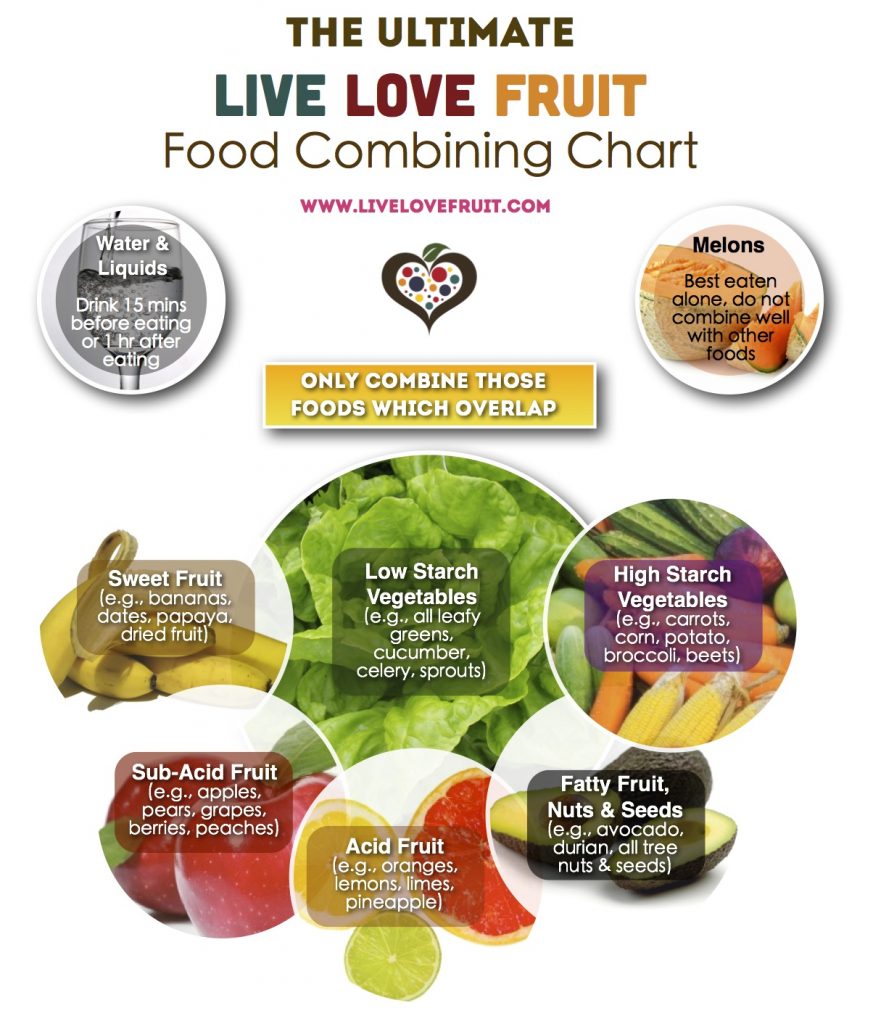
Below is a quick guide to help you learn how to properly combine your fruit and vegetables and return yourself to a state of health and wellness:
Water & Liquids:
Drink 15-20 minutes before a meal, or drink 1-2 hours after eating a meal
Melons: (e.g., watermelon, cantaloupe, honeydew, santa claus melon, etc.)
Best eaten alone, do not combine well with other foods (digest very quickly – if you eat melon, be sure to eat it in the morning on an empty stomach). Melons are more than 90% liquid, and leave the stomach quickly if they are not backed up and fermented by combining with other foods, or slower-digesting foods eaten later in the day.
Sweet Fruit: (e.g., bananas, dates, papaya, all dried fruit, figs, jackfruit, mamey sapote, longan, mangosteen, persimmon, sapote)
Combine well with most sub-acid fruits and low-starch vegetables (particularly cucumber, celery and light leafy greens; I would not combine sweet fruit with anything more than these low-starch vegetables). Do not combine well with acid fruit, fats, or high starch vegetables.
Sub-Acid Fruit: (e.g., apples, blackberries, blueberries, raspberries, cherimoya, cherries, grapes, loquat, lychee, mango, nectarine, peach, pear, plum)
Combine well with sweet fruit, acid fruit and low-starch vegetables. Do not combine with more than one other fruit at a time (for example, don’t eat sub-acid fruit with sweet fruit AND acid fruit, just eat sub-acid fruit with sweet fruit, or sub-acid fruit with acid fruit; e.g., eat a pear with papaya, or eat a pear with an orange, but don’t eat a pear with a papaya with an orange, because the papaya and orange will ferment)
Acid Fruit: (e.g., cranberries, grapefruit, kiwi, strawberries, kumquat, lemons, limes, oranges, pineapple, pomegranate, tangerine, tomato)
Acid fruits combine well with sub-acid fruit and low-starch vegetables (as well as some higher starch vegetables; this mainly applies to tomatoes), as well as fatty fruits, nuts and seeds. Do not combine acid fruit with sweet fruit!
Fatty Fruit, Nuts & Seeds: (e.g., avocado, durian, olives, all tree nuts like pistachios, walnuts, almonds, macadamia nuts, cashews, and seeds like hemp seeds, sunflower seeds, pumpkin seeds, and chia seeds)
Combine well with low-starch vegetables and high-starch vegetables as well as acid fruit. Do not eat more than one fat at a time. For example, don’t eat avocado and nuts, since these proteins digest at different rates. Fats combine very well with simple leafy green salads!
High Starch Vegetables: (e.g., carrots, beets, peas, winter squashes (acorn, butternut), water chestnuts, parsnips, potatoes, sweet potatoes, corn, plantains, broccoli, cauliflower)
These vegetables can be eaten with fats, and low-starch vegetables, however I wouldn’t suggest eating them with more than one fat at a time. For example, I would not eat an avocado, nuts and a potato, but avocado and potato are fine.
Low Starch Vegetables: (e.g., sprouts, leafy greens, hearty greens (kale, collards), herbs, bok choy, celery, radishes, sea vegetables, mushrooms, cabbage, jicama, asparagus, okra, cucumbers, green beans and wax beans, fennel, peppers, zucchini, green onions, eggplant, celery, onions, leeks)
These vegetables combine very well with all of the previously mentioned fruit and vegetables. Always remember that the simpler the meal, the simpler the digestion. Keep your meals under 6 ingredients to allow the body to digest the foods properly and assimilate all the available nutrients.
Click the chart below to print out a larger version for your kitchen!







this was amazingly helpful!
How far in between are you talking to separate these foods that don’t mesh? Two hours? Fours Hours? 24 hours?
Some foods take longer to digest. Fruit is generally between 30 mins – 1 hour. Veggies are around 1 hour, and fats are longer around 4-6 hours. Then once you get into animal products it takes even longer.
Hi Carly
I need to know the best fruit and dry fruit combinations… like apples with cashew or almonds? Can you help with some info on it ..
Siddhesh
Apples can be eaten with cashews or almonds – it isn’t the best combination but you just have to experiment with your own body and how it reacts.
Hi there:)
The article says that you’d need to separate sweet and acid fruits etc. and it’s best eaten 20 minutes before your next meal (Other article)
I was just curious, does this combination work?
Blueberries + Strawberries (Acid fruits)
20 minutes gap
Apples (Sub Acid fruit)
20 minutes gap
Bananas (Sweet fruit)
Would love it of you could help me out, thanks! 🙂
Hey Neelabh,
That combination should work out just fine. See how your body responds!
This article only covers fruits and vegetables and fats. Do you have any research on animal product proteins like meat and cheese and eggs? You seem very knowledgeable so that is why I am asking.
Oh and grains as well. I meant to ask that too. I'm just looking to better combine foods from the whole spectrum.
Here is a good resource: http://www.gillianb.com/food-combining/
Hey Chris,
Unfortunately, I do not know much about combining animal fats and proteins. Sorry!