
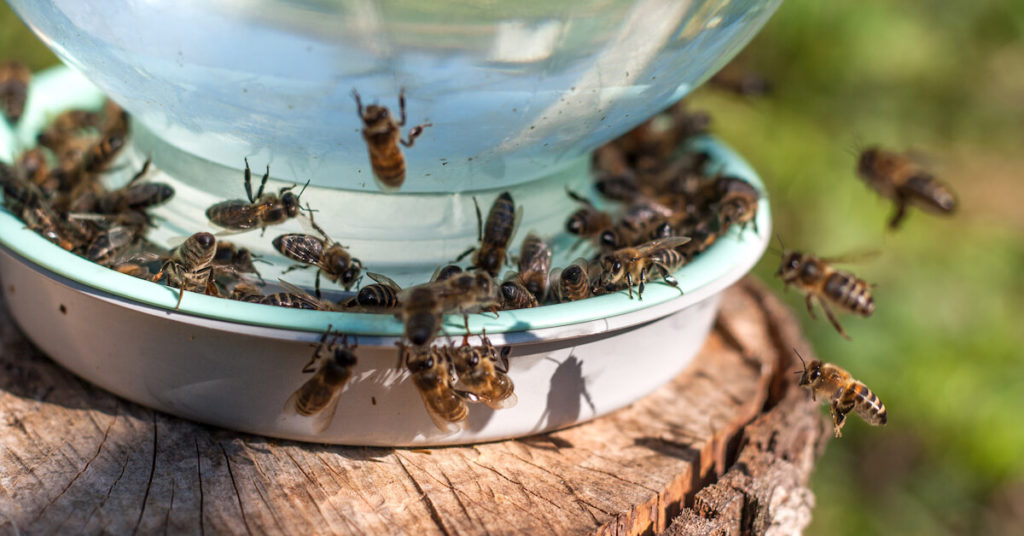
Not many people are aware that bees drink water. They also don’t know that bees need a safe source to access so that they don’t drown.
For this reason (and more) I want to teach you how to make a bee waterer!
Imagine how hard just one bee works in a single day. Tending to over 2,000 flowers daily, beating their tiny wings over 10,000 times per minute, and carrying pollen.
Sounds like quite the exhausting task, right?
As a result, bees get thirsty and need safe water sources.
Since bees can’t drink while flying, they have to land in order to do so. However, this brings up the conundrum of how to land safely near a spot of water without drowning, and without getting eaten alive.
Bees often risk drowning in birdbaths or being eaten at rivers and lakes among birds, fish, frogs and other wildlife.
This is why bees often fly around our clotheslines, and may even land on us if we are in an outdoor pool on a hot day. They’re seeking out safe water sources, and simply doing the best they can while trying their best to avoid uncertain death.
Before we get into how to make a bee waterer (and there are many different versions you can make), let’s delve a little into why bees need water and why you shouldn’t add sugar to the water.
Do Bees Drink Water?
Bees need water just like every other life form on earth.
Perhaps you’ve seen a bee or two in your lifetime, taking a break on leaves with fresh dew, or perhaps on the edge of a birdbath. If you took a closer look, you’d probably see their tiny tongues sipping up the water that they so desperately need.
According to Eric Mussen, retired apiculturist of the UC Davis Department of Entomology and Nematology:
“Like most other animals, the bodies of honey bees are mostly water,” he points out. “Thus, they need to drink water routinely as we do. Additionally, water (or sometimes nectar) is critical for diluting the gelatinous food secreted from the head glands of nurse bees, so that the queen, developing larvae, drones, and worker bees can swallow the food. They use water to keep the brood nest area at the proper relative humidity, especially when it gets hot and dry outside the hive. Water droplets, placed within the brood nest area, are evaporated by fanning worker bees and that cools (air conditions) the brood nest area to keep the eggs and developing brood at the critical 94 degrees Fahrenheit required for proper development.”
Mussen further adds that on extremely dry, hot days, bees will stop collecting pollen and search out water instead. “Under those conditions, it has been estimated that the bees may be bringing back nearly a gallon of water a day.”
Providing bees with a safe water source, then, could be key in ensuring the survival of an entire bee colony.
Some bees will even fly up to nearly five miles to find a safe water source, according to Mussen.
Providing alternative water sources in your garden (like the bee waterers I will show you how to make down below) is also a great way to deter them from taking a dunk in the pet water bowl, in your pool, or on your wet clothesline.
If they know a safe water source exists in your back yard, they’ll be sure to visit that area first, before risking their lives around pools, birdbaths or water bowls.
Don’t Feed Sugar Water to Bees
Another thing I want to point out is that it is not necessary to add sugar to the water source you provide for your bees. In fact, it could be doing more harm than good.
In the summer of 2018, a very popular Facebook post quoting David Attenborough claimed that feeding sugar water to exhausted bees would help save them. Thankfully, this post was marked as fake news and taken down – but not after thousands of people had already seen and shared it.
The truth is, David Attenborough, a well-known broadcaster and naturalist did not make the statement. Someone created the quote under his alias and it went viral.
Bees actually do not need to be fed sugar water and will benefit more from plain water in a bee waterer.
Feeding bees sugar water means the bees will by-pass their instincts to gather pollen and nectar from flowers. If they know an easy sugar source is nearby, they’ll go for that, and tell the entire colony.
Once the entire colony starts bringing back sugar water, they start creating a version of honey that is watered down. This is not beneficial for the colony.
Sugar water is the equivalent of feeding insects junk food. It is full of carbohydrates, which will give them a burst of energy, but it has no nutritional value (unlike pollen).
The pollen that bees normally bring back to the hive is used to feed growing larvae. If you have an entire colony of bees bringing back sugar water, the larvae will likely struggle to grow, and end up weak and fragile.
Overall, it’s not a good idea. Leave out the sugar, and stick to water.
How To Make a Bee Waterer
There are a few different ways you can make a bee waterer.
The first, and by far the easiest way to create a bee waterer is by grabbing a shallow bucket or bowl (or one of the bottom saucers of a planter), adding some marbles or stones and then putting enough water in to just cover the edges of the stones, but not completely (so the bees have somewhere to sit).
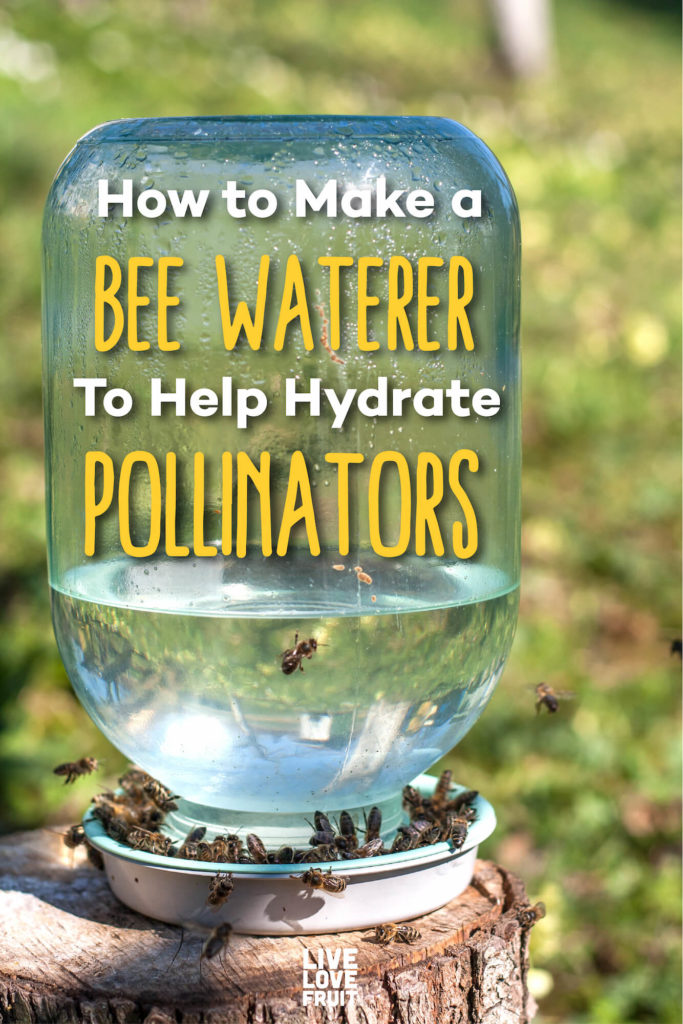
The other option is by filling up a mason jar or old pickle jar (cleaned, of course) with filtered water, screwing on a sprouting lid on top, and then placing a saucer on top of the lid. When you turn this contraption around, the water will fill the saucer just enough to provide water for bees. You can also add some stones around the edges to provide more landing areas for bees.
The second option is a bit easier since you don’t need to replace the filtered water every day (especially if you keep it in a shaded area in your garden). You would only have to replace it once a week.
With the first option (marbles and stones), you should change out the water once every couple of days.
So with that being said, here is what you need to create your bee waterers to ensure our pollinators have a safe space to stay hydrated over summer.
What You Need:
– clear glass marbles or pebbles
– shallow bowl or pan
– mason jar or pickle jar
– plastic sprouting lid
Marble/Pebble Bee Waterer Instructions:
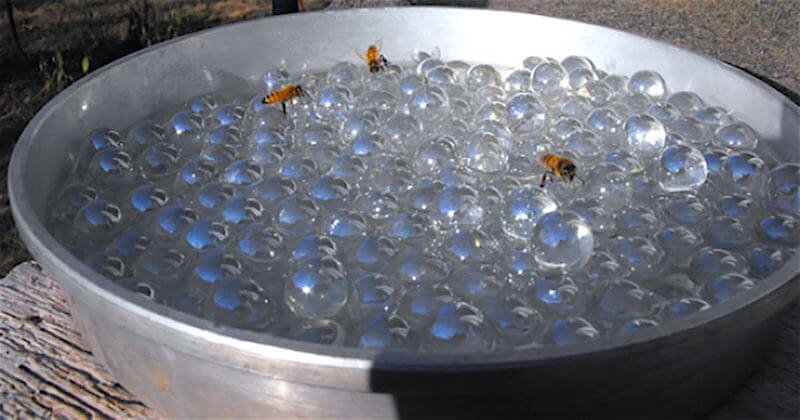
- Put the marbles or pebbles into a shallow bowl or pan.
- Fill with water so that you can see little rivers of water between the marbles (don’t cover the marbles completely).
- Place outside in a shady location, preferably somewhere off the ground so that the bees can safely take their time getting hydrated.
- Check the water daily to make sure the water levels are adequate. Also, clean the marbles/pebbles and bowl about 1-2 times a week – this will also prevent mosquitoes from proliferating and laying eggs in the still water.
You can also get creative and add moss, flowers, shells, and other decorative pieces to make your bee waterer really unique, like the station in the video below:
Glass Jar Bee Waterer Instructions:
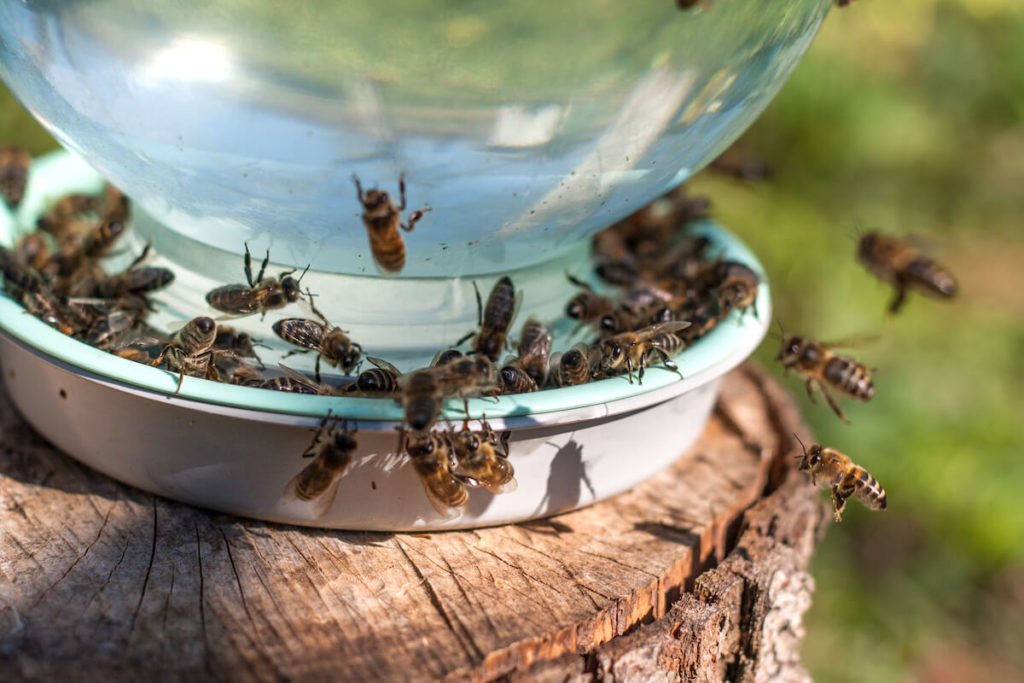
- Fill a clean mason jar with filtered water and screw on a plastic sprouting lid.
- Place a saucer on top, and hold the jar tightly to the saucer while turning around so that the mason jar is upside down. Some water should slowly trickle through to fill the saucer.
- If the water is taking some time to filter through, you can also wedge some pebbles between the saucer and the lid to encourage the water to flow. It won’t completely fill the saucer, because of the way gravity works (there are lots of physics videos on YouTube about this!).
- Fill around the saucer with pebbles and marbles to provide more landing and safe spaces for the bees to land.
- Place outside in a shady location, preferably somewhere off the ground so that the bees can safely take their time getting hydrated.
- Check the water daily to make sure the water levels are adequate. Once a week, clean the mason jar, sprouting lid, saucer, and pebbles, and repeat the process.
The Bottom Line
Making a bee waterer is a fun, easy, and cheap way to help provide water to exhausted and dehydrated bee colonies. Bees need access to safe water sources as they can easily drown in birdbaths and pools.
When making your bee waterer, be sure to not add sugar as this can harm the bee colony and make them dependent on the sugar water instead of seeking out their natural food source – pollen.
A bee waterer can be made with just marbles and a shallow pan, or with a mason jar, some pebbles, and a shallow dish. Don’t forget to have fun with it!





Hey Carly!! Thank you for sharing your spectacular ideas! We don’t have flowers anymore, too unstable to tend them, BUT I’ve been looking for ideas to hydrate our little buzzing buddies and I have found them thanks to you!!