

Suffer from low back pain? You might have a weak core.
In fact, 1 in 10 people around the world are afflicted with low back pain. Two-thirds of Americans say that low back pain has affected their ability to engage in tasks of daily living, exercise, and sleep.
With over 72% of people reaching for pain medications like Advil to alleviate their symptoms, we can see that back pain is a real problem. Fortunately, there is an easier, and more reliant form of reducing back pain – it just might take a little effort.
The Core and The Back
Utilizing core stabilization exercises to get rid of lower back pain is one of the best things we could do for our body.
When we think of ‘core’ we usually think of just the abdominal muscles, however, that is a huge myth that needs to be dispelled. You don’t need chiseled abs to have a strong core, and if you have chiseled abs, that doesn’t mean you have a strong core.
Our core becomes weak when we lead a sedentary lifestyle and include very little exercise into our day-to-day schedules. If you’re a living, breathing, walking human being, you need to train your core. A weak core will dramatically increase your chances of hip, back, knee, neck and shoulder problems.
Spinal stability, according to Dr. Manohar Panjabi (coauthor of Clinical Biomechanics of the Spine), consists of three specific parts:
– Passive tissues of the spinal column
– Active control via spinal muscles
– Neuromuscular control / coordination
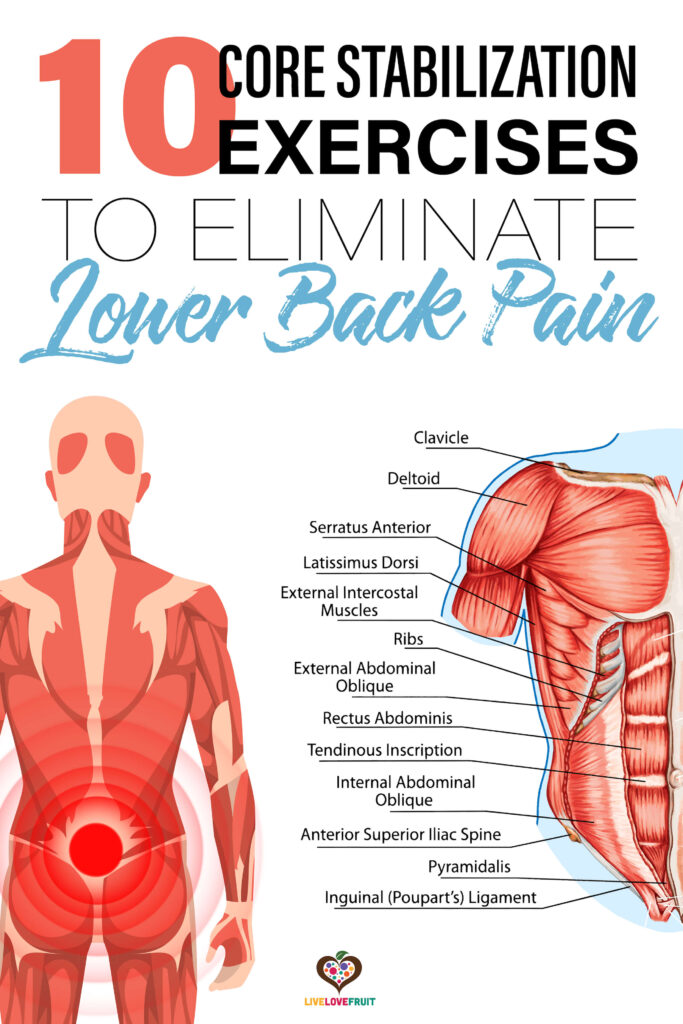
The core is made up of several muscles, as well as several layers of muscles. Although most people are just concerned with making their abs look great, and so only focus on the rectus abdominus and obliques, they aren’t actually really doing anything when strengthening these muscles. The muscles underneath these muscles (the ones you can’t see) are actually the most important.
These include muscles like the psoas muscle and spinal erectors, as well as any other muscle that attaches to the pelvic girdle (such as the glutes, hip flexors, latissimus dorsi, etc.). These muscles help stabilize the spine and skeletal structure while standing or doing any kind of activity. When all of these muscles work together synchronistically, it creates what we call a “core.”

Due to too much sitting, and lack of proper core exercises, all of these muscles become weak, which in turn leads to a weak core. When these internal muscles become weak, they have a hard time stabilizing the spine – their main function in the human body. Over time, this leads to low back pain, as the spine starts to compensate for your stabilizer muscles in holding you up. Weak stabilizer muscles also leads to poor posture, which puts you at risk for developing serious spinal and/or disk injuries.
Core Strength vs. Core Stability
Core strength and core stability are two different things. You can see how much core strength you have by simply doing a plank and seeing how long you can hold it – the stronger the core, the longer you’ll be able to hold a plank.
Core stability is more less how well aligned the spine and pelvis are while performing any activity.
What Are The Best Exercises For The Core?
The best exercises for the core are those that don’t involve laying on the floor and staring at the ceiling. That’s right – crunches aren’t doing much to stabilize core muscles. They also put massive stress on your spinal discs by compressing and stretching them in an unnatural way.
However, crunches performed on a stability ball have just the opposite effect. When you crunch on a stability ball, your spine doesn’t go into flexion, and you’re engaging smaller core muscles that you don’t get with the traditional crunch.
Top 10 Core Stabilization Exercises
So, without further adieu, here are the best core stabilization exercises for low back pain. Do these exercises 2-3 times a week to start stabilizing your core muscles. As you start doing these exercises, you’ll notice a tighter, more toned waist that has almost been “tucked” in.
1. Plank
1. Beginning on your hands and knees, put your weight on your elbows directly under your shoulders.
2. Extend your legs behind you, grounding your toes into the floor and squeezing your glutes to stabilize the body.
3. Neutralize the neck and spine by looking at a spot on the floor about a foot beyond your hands.
4. Keep your core tight, pulling in your abs, while making sure your body stays in a straight line.
5. Hold the position for as long as you can, aiming for 20 seconds the first round.
6. As you get more comfortable with the plank over time, you can hold it for as long as possible without compromising form or breath.
2. Bird Dog
1. Remain on all fours and tighten your abdominal muscles, keeping your spine and neck in neutral position (you should be looking at the floor).
2. Extend your left leg behind you while reaching your right arm forward.
3. Keep your hips square, and make sure you don’t arch your lower back.
4. Hold for 10 seconds, and slowly return to starting position. Now do the move on the opposite side.
5. Complete 5-10 repetitions on each side.
3. Side Plank
1. Start on your side with your feet together and one forearm directly below your shoulder.
2. Contract your core and raise your hips until your body is in a straight line from head to feet.
3. Hold the position for as long as you can (30 seconds minimum), keeping your glute muscles engaged without letting your hips drop. Repeat on the other side.
4. Bridge
1. Start by lying on your back with your knees bent and feet flat on the floor.
2. Engage your glutes and core, lifting your hips toward the ceiling. There should be a straight line from your knees to your shoulders at the top of the movement.
3. Hold for a few breaths at the top, and then lower.
4. Repeat 10-15 times.
5. Kettle Bell Swings
1. Stand over the kettle bell with feet hip-width apart, chest up, shoulders back and down. Use a kettle bell that is a bit lighter to begin with, so that you can practice form first instead of sacrificing form for strength.
2. Squatting down, grip the kettle bell with palms facing you and thumbs wrapped loosely around the handle.
3. Stand tall, gripping the kettle bell. Keep your arms long and loose, retracting your shoulders blades and engaging your core.
4. Soften the knees, shift your bodyweight into your heels and lower your buttocks down toward the wall behind you.
5. Driving through your heels, explode through the hips to send that weight swinging upwards from your quads. Aim for chest height with arms extended. Your core will naturally contract, and so will your butt cheeks.
6. As the kettle bell descends, let the weight do the work as you ready your body for the next rep.
7. Repeat 10-15 times.
6. Stability Ball Crunches
1. Sit on a large stability ball with your feet flat on the floor.
2. Walk your feet forward, letting your entire back rest on the ball and keeping your thighs parallel to the floor.
3. Cross your arms over your chest and tuck in your chin slightly.
4. Contract your abs and exhale as you raise your torso about 45 degrees.
5. Pause, and then lower, inhaling as you go. If you feel unstable, move the feet further apart.
6. Do 8-10 repetitions.
7. Stability Ball – Stir-The-Pot
1. Once you are really good at doing a plank, you can safely and effectively perform this exercise.
2. Get in the forearm plank position with your forearms on a stability ball instead of the ground.
3. Once you’re stable, start to rotate your arms in little circles, forcing your core to engage.
4. Make the circles as wide as you can without falling off the ball.
5. Perform this for as long as you can, increasing the amount of time you do it each week.
8. Stability Ball Hamstring Roll-Ins
1. Start by lying on your back, with your arms by your side and heels on top of the stability ball.
2. Squeeze your glutes and abs and lift your body up so you are in a straight line, with only the shoulders and head relaxed on the floor.
3. Keeping your hips elevated throughout the exercise, roll the ball toward your glutes, and then slowly extend it back out.
4. Repeat 10-15 times.
9. Stability Ball Pike
1. Begin in a pushup position with the tops of your lower shins on your stability ball.
2. Roll in the ball toward your chest, while lifting or “piking” your hips to the ceiling and engaging the core.
3. Slowly lower to your starting position and repeat 10-15 times.
10. Stability Ball Grasshopper
1. Start in a plank position with your hands beneath your shoulders, body in a straight line.
2. With both feet on top of the stability ball, tuck in your right knee toward your chest, rotating slightly and extending your right foot across the opposite side of your body.
3. Alternatively, you can just bring your right knee toward your right elbow, or as close as you can go.
4. Avoid rocking the ball back and forth by engaging your core as you return your foot to the top of the ball.
5. Switch legs, and repeat 10-15 times, alternating legs.




Leave a Reply