

Hoo-guh-what?! Hugelkultur, pronounced, “Hoo-Gul-Culture,” means hill culture or hill mound in German. Hugelkultur raised beds are no-dig raised beds that hold moisture, build fertility and maximize surface volume so that you get double the yield when harvest time comes.
So, instead of putting all of your raked branches, leaves, and grass clippings in bags by the curbside, build a hugelkultur raised bed!
What Is Hugelkultur?
According to permaculture expert Paul Wheaton:
“Hugelkultur is nothing more than making raised garden beds filled with rotten wood. This makes for raised garden beds loaded with organic material, nutrients, air pockets for the roots of what you plant, etc. As the years pass, the deep soil of your raised garden bed becomes incredibly rich and loaded with soil life.”
Hugelkultur raised beds are similar to lasagna gardening and sheet mulching – methods that require no digging and no tilling, and which result in rich, fluffy soil with very little work from the gardener. Hugelkultur raised beds, like lasagna gardening and sheet mulching, are particularly effective in areas with poor soil quality, because they are built above the soil surface. The layers of these methods help hold nutrients in the soil much longer than if compost or fertilizers were applied directly to the soil surface.
While Hugelkultur is similar to gardening methods like lasagna gardening and sheet mulching, it still differs in a few key ways (1):
1. Woody Base
Hugelkultur raised beds depend on a foundation of wood. This includes things like tree trimmings, logs, clean scrap lumber or even trees that have fallen over. The slow break down of this woody base keeps soil fertility and moisture retention strong over years or even decades.
2. Size
You can make your hugelkultur big or small, but some of them have been built as high as six feet tall! In some cases, hugelkultur raised beds are build over entire fallen trees. While the sky’s the limit for building a hugelkultur, most people only have room for hugel beds that are one to two feet tall – and that’s totally fine!
3. Steeply Sloped Sides
Hugelkultur beds also come with steeply sloped sides. Keeping the sides sloped at 45 degrees is thought to reduce soil compaction over time, as well as increase soil oxygenation.
4. Moisture Retention
The woody base of the hugel bed slowly breaks down over time – the cellulose and lignin-eating fungi slowly consume the woody base material, transforming the logs, branches and wood chips into sponge-filled masses with tiny air pockets. These tiny air pockets create excellent moisture-retainers, which encourage strong plant root growth. Even in dry climates, the smallest of hugels can go weeks without supplemental irrigation. Large hugels, on the other hand, can support lush growth through an entire summer without additional water.
The Benefits of Hugelkultur Raised Beds
There are so many benefits of building a hugelkultur raised bed.
For starters, they work very well in dry areas, even deserts, due to their outstanding ability to hold water. They require little, if any, irrigation, making them an incredibly sustainable addition to any garden. They also don’t need any fertilizer, because they are planted in almost pure compost, which is very nutrient-dense.
The beds create different microclimates suitable for the varied needs of different plants. For example, the side facing the sun can be used for plants that require direct sunlight, where as the shadier side can be used for delicate leafy greens and kale, for instance.
The wood used underneath the hugel bed slowly decomposes over time, so the soil warms up faster in the spring (compared to conventional flat-bed gardening). This helps the growth and germination of seeds, particularly in the spring, and allows for an earlier start of growth.
The soil is also loose and well aerated, meaning that it doesn’t freeze as fast in cooler areas.
The nutrients locked up in the wood get released slowly over a period of several years. Even vegetables with a high nutrient demand can be grown without the use of additional fertilizer.
Last but not least, the method of hilling, or sloping the raised bed, helps to increase surface area, allowing for more grow space. This is particularly useful in small gardens with limited space.
How To Make A Hugelkultur Raised Bed
The rising popularity of hugelkultur has to do with its association with permaculture. Permaculture is an increasingly popular gardening philosophy that seeks to mimic and incorporate natural relationships and systems into the garden.
If you are wanting to incorporate a hugel bed into your garden, you’ll want to think about the system as a whole. The beds you build are long-term, and will get better as the years pass on.
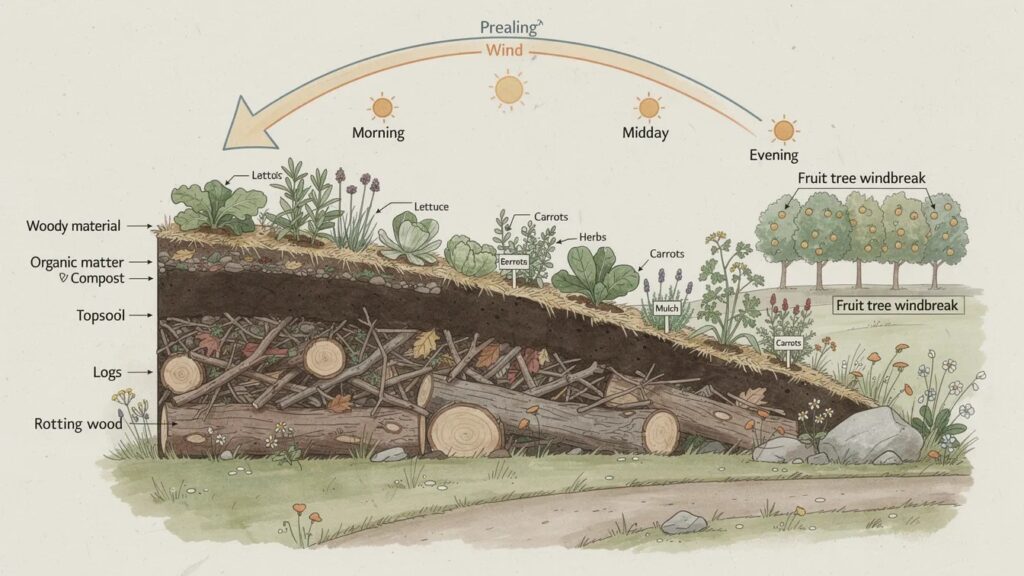
There are a few key things you will want to consider before building your hugel bed:
1. Sun
Some hugel beds are built running east-west so that the mounded bed has a hot and sunny south side and a cooler shaded north side. If you want to plant vegetables and fruit that require plenty of direct light, run the bed north-south so that your crops receive more even light exposure. If you’re planting a combination of direct light and low light vegetables and greens, then running east-west is your best bet.
2. Water
Look at the water flow in your garden, and pin-point the areas that are low-lying and moist, and the areas that are easily drained. If you position your hugel strategically, it will soak up, or re-direct excess water. If there is too much water, however, it can undermine the bed’s structure.
3. Wind
If you plan on making a really tall hugel bed, you will be modifying the air-flow in your yard. You’ll want to think about where the dominant winds come from in your climate, and what areas might benefit from a wind-block in your garden. You’ll also want to consider what you plan on growing in your hugel. Crops that are planted on the top will have little shelter, and will have to cope with lots of wind if planted in an exposed, windy location.
4. Shape
The shape of your hugel doesn’t have to be perfect. A lot of them tend to take freeform shapes like gentle arcs, open bowls, or whatever shape would be best suited to the climate (taking light, water and wind into consideration). After all, some hugel beds have been built over fallen trees!
5. Location
If you have termite issues, avoid building your hugel too close to your home.
6. Type of Wood
Depending on the size of your hugel, you will need varying amounts of wood. If you know you want to add hugelkultur into your garden, start saving logs, cut branches, tree trimmings and other garden wood, even if you’re not sure where they’ll end up.
Some woods contain natural chemical agents that make them very slow to break down, so in that case, you’ll want to avoid:
– Cedar
– Black locust
– Black cherry
– Black walnut
Any wood that is chemically treated (not naturally), like pallets, painted/stained wood, or pressure-treated wood should not be used. Wood chips can be used, but it will not offer the same longevity of fertility that a classic hugel full of larger logs and timbers would.
Building Your Hugelkultur Raised Bed
Below are the steps to building your hugelkultur raised bed.
STEP 1. Lay down your scrap wood (freshly cut, well-rotted, or anything in between), with larger trunks and stumps on the base, and smaller twigs and branches up top. Water well.
Tip: The bigger the better. The larger your mound is, the more resilient it will be in regards to irrigation and fertilizer. The recommended size is about two metres by one metre with a height of about two metres. While you don’t have to make your hugel this large, it is recommended, as it will allow for shrinkage in the first month as it settles down.
STEP 2. Fill the gaps of the wood with compost, manure, leaves, kitchen-waste, etc. This nitrogen-rich layer will help balance high levels of carbon in the wood. Covering your hugel with grass sod face down is also highly recommended (always make sure the grass sod is face down, as the grass might grow through again if faced up).
STEP 3. Finish with a layer of topsoil about 5 cm deep and then a layer of mulch (like straw).
STEP 4. You can plant in the hugelkultur raised bed right away, but if you allow it to cure (like over winter), it will give it time to settle and soak in rainwater. However, if you don’t want to wait and want to plant in the hugel right away, you are doing no harm in doing so.
Note: You can start off with smaller/lower beds and add to them over a few years to create a taller bed. However, the smaller beds won’t be as resilient and will require some watering (although far less than a ‘normal’ raised bed containing just soil and compost).



Ok I just built ours after reading this, I did not pay close attention so it went like this: Dug up sod, added oak branches that were downed last year, added dead brown oak leaves, sod back on dirt side up, fresh straw and rotting straw, then store bought garden soil two inches thick. Water. Next day toss seeded with lettuce, spinach, kale, tansy, marigold, arugula, spinach, broccoli and just for the heck of it some leeks. Water. I hope this works lol….
That’s amazing! I hope it works well for you – it sounds like you did a great job! Let us know how it works at the end of summer 🙂
Wood uses lots of Nitrogen as it breaks down, usually from the air or the soil it is in contact with. Where do the new plants get there Nitrogen from?
Hey Bob, I found the answer to your question on a permaculture Reddit board as I have never considered it before:
“The bacteria breaking down the carbonic material require it and will leech it from the soil. It is suggested you throw some greens on top.
Consider that the outer edge of the wood underneath that soil is going to be the drain on N and that process will depend on the shape and state of the wood itself. Wood chips and other mulch material will be a far greater drain on N in soil than what is typically suggested for hugel. It’s is better to use branches, logs etc. Because these shapes are more contained and have far less surface area exposed to the soil their N requirements will be less as they will be decomposing at a slower rate.
Consider also that good hugel uses a lot of soil. Like lots! 3 feet of wood with 3 feet of soil on top is a good size. Some roots may not even make it down to the areas that are being denuded of N As long as there is a decent amount of nitrogen in your soil you should be fine with mitigating the N deficiency with that layer of greens but I have also heard of people who have a planting schedule that eases into species with higher N requirements. They may start the hugel with a green manure and turn it in as well.”
I have honey fungus in my garden. This seems like a pretty dangerous addition to it. What do you think?
Hmm, I don’t really know if that would affect a hugelkultur. Have you tried planting things that would repel the honey fungus?
How does this work if you have really wet ground part of the year? Would it be a good barrier to keep arising creek away from other plants inside the barrier? Would plants still grow?
Hey Gary – I’m not sure if a hugel would work as a good barrier for your creek, but it wouldn’t hurt to try.
Wow, I have just been given your article and happen to have several tonnes of garden and tree waste that I was planning to chip – at great expense of fossil fuel. I can start building now as we go into southern hemisphere winter!
I also see the question of nitrogen addressed in Wikipedia.
Thanks very much.
Glad you’re going to take advantage of all that waste and turn it into something useful! 🙂