

UPDATE: On June 3, 2019, the USDA clarified its standards regarding organic crop container systems, requiring that container-based operations must also stop using synthetic chemicals not approved for organic crop production for three years prior to achieving certification, both in the containers as well as on the soil underneath.
There has been a lot of news surrounding glyphosate in the last few years, and for good reason, too. After the World Health Organization classified glyphosate as a Group 2A carcinogen (aka. “probable human carcinogen”), and people started getting justice from the company whose products caused their cancer, Monsanto (now Bayer) has been under massive scrutiny.
With the massive out-cry for Monsanto to stop poisoning the planet, one would think that the last thing an organic growing operation would do is start adding these products to their food. At least, that would be the logical thing to assume. Unfortunately, this is not the case.
Glyphosate in “Organic” Hydroponic Food Production
The National Organic Program (NOP) recently announced that they are now allowing glyphosate in “organic” hydroponic food production. Using common sense, this would rightfully deem any product non-organic – but this doesn’t seem to be the case for hydroponics.
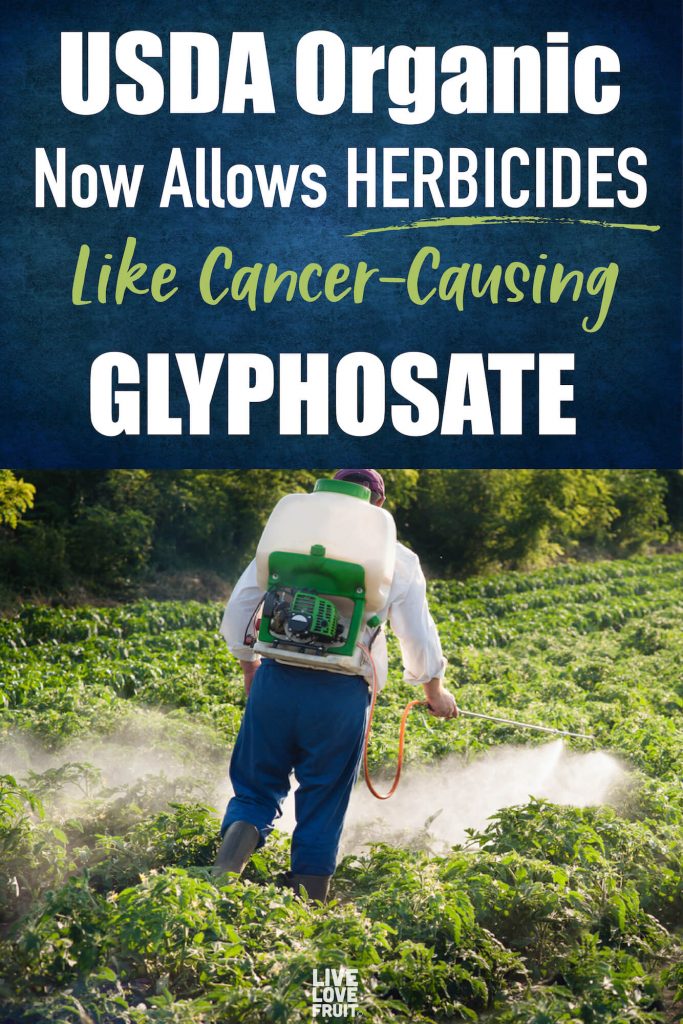
Now, glyphosate (an incredibly toxic herbicide that is absolutely prohibited on organic farms) is being sprayed on fields prior to constructing hydroponic greenhouses awaiting organic certification. This is done to remove weeds from the greenhouses.
The issue was brought into light by the Real Organic Project, a family farmer-driven organization that is pushing for an add-on label to USDA certified organic to provide more transparency on these farming practices.
In his long e-mail addressing the situation, Dave Chapman, Executive Director of Real Organic Project, explains how faux-ganic produce is being sold to unsuspecting consumers.
“I have been hearing for months that glyphosate is being sprayed on fields about to be certified organic for hydroponic berry production. The way this use of herbicide is incorporated into “organic” certification is to laser level a field, compact it until it is like a parking lot, wait a little while until the weeds (that slows follow disturbed soil) have germinated. And then spray it with an herbicide. They are doing this in California and Florida. The weeds in Florida are fierce, and can grow straight through the black plastic. Weed control in organic blueberry production is the biggest challenge. Being able to spray glyphosate and sell it as organic is an enormous economic advantage.”
Dave Chapman, Executive Director of Real Organic Project
While Chapman and his team posed their concerns to the NOP, they’re not doing a great job of dealing with the “complaint.” Since herbicide-sprayed “organic” produce is faster and cheaper to produce, the grocery store price tag is also cheaper. As a result, real organic farmers who put time and effort into organic weed control are becoming less preferable to customers. After all, who wouldn’t buy a cheaper pack of unsuspecting faux-ganic tomatoes over real organic tomatoes? If the consumer doesn’t spot the difference, then they’re going to go for the cheaper option.
Marie Burcham, an attorney and director of domestic policy for Cornucopia chimed in after news of the inclusion of hydroponics into USDA organic certification. “It’s vital that consumers understand what is happening here…If you see cheap ‘organic’ tomatoes or berries out of season in your area, those are almost certainly hydroponically grown! They are often so cheap, they are putting real organic farmers — farmers who care about the health of the land they farm — out of business.”
Besides the fact that it is obvious that organics cannot and should not be sprayed with glyphosate, the NOP continues to assert that hydroponic, aquaponic, and aeroponic production is allowed (1). NOP argues that because glyphosate does not “touch” the plants being certified, it is technically still “organic.” If that’s not the craziest assumption I’ve heard in regards to organic food production, I don’t know what is. For those of you who don’t know – anything that touches the soil eventually gets taken up by the plant. It becomes apart of the plants tissues and DNA. It is unavoidable.
Herbicides in Hydroponics: Is It Really That Harmful?
We cannot ignore the fact that glyphosate in “organic” hydroponics is making it difficult for real organic farmers to sustain their love of the land in a holistic way.
As Chapman says (2):
“The world is changing, and it is changing fast. Once again, the soil farmers are being pushed out of the market by a tidal wave of cheap product. Once again people will go out of business who are growing exactly what customers WANT to buy. Once again, we lose our choices in the stores. Once again we are misled. Once again the USDA fails us.”
Dave Chapman
Chapman reached out to Jennifer Tucker, the head of the NOP. According to Jennifer, because the plant itself is not being exposed to prohibited substances like glyphosate, spraying the ground with herbicides the week before organic certification is 100% legal. And according to Jennifer, there is no real reason to gather evidence and file a complaint, because of the legality of it all. The opposing party would never win a legal battle, because of the fact that glyphosate isn’t “touching the plant.”
This is all because the USDA does not consider spraying toxic herbicides like glyphosate on the soil immediately prior to inspection to be a disqualifier for organic certification.
According to Chapman, “USDA organic is a voluntary program. It was idealistically created to PROTECT farmers and eaters from fraud. Now it is supposedly the very fraud it was meant to be preventing. And the USDA makes clear they have no intension of changing, regardless of what we, the people, think.”
Aside from the glyphosate allowance, hydroponic producers are also given a blanket exemption from the three-year transition period, which is required for all other organic farmers. This is the time frame where the land must be certified free of prohibited substances, including herbicides like glyphosate.
Hydroponic operations also don’t take into consideration the health of the soil. As the soil becomes compacted and soaked with agrichemicals, the delicate microbiome of the soil is destroyed. The whole point of growing organically is to ensure this planet stays healthy and chemical-free.
People vote with their dollar, so if people are voting on organic hydroponics that aren’t actually organic, the need for more chemical contamination will soon become the norm. This is not how we move forward. Not for the planet, and not for future generations.
What Can Be Done?
Trying to decide whether the organic produce you’re purchasing is actually organic might be difficult, there are some rules you can use to weed them out. Some packages might blatantly state that the organic produce is hydroponically grown, but if it’s not, there are a few other tips you can use.
If there are fresh berries available during a time when they are not seasonal (like in the dead of winter) and they’re labelled organic, and have a lower price tag, they’re probably not actually organic. The same goes for tomatoes and other organic produce that doesn’t normally grow abundantly at certain times of the year. You can find my guide on seasonal buying here.
Growing your own food is also a very viable option, but not accessible to many.
Supporting organizations like The Real Organic Project who is working to create more honest ways for people to find and buy the food they want from farmers they actually want to support is another great option. As mentioned above, they’re currently working on creating an add-on label that will more clearly identify the real organic food that people actually want. I’m excited to see what the future holds for this company, and the add-on label they’re so desperately trying to put into effect.




I think you article intentionally muddies the waters here, not clearly describing what is going on. In my opinion this is a grey area. The thing that is being sprayed is not the product. It is not the soil the product is being grown in. I can see how there is a LEGAL grey area. It can be tough to write law that covers every possible scenario on the front end. This is why i will eternally be against government definitions on food. Government is not the proper entity to define organic. It would be better to have competing private organic inspection companies each giving their own stamps.