• Skip to primary navigation
  • Skip to main content
  • Skip to primary sidebar
  • Skip to footer
live love fruit logo

Live Love Fruit

Eat Vibrantly. Live Vibrantly

About Start Here Work With Me

  • Home
  • Start Here
  • About
  • Health
  • Remedies
  • Recipes
  • A-Z Conditions
  • Fitness
  • Environment
  • Self Improvement
  • My LLF
  • Shop
Category: > Health > The 2024 Dirty Dozen List: Top Foods to Always Buy Organic to Avoid Pesticides

The 2024 Dirty Dozen List: Top Foods to Always Buy Organic to Avoid Pesticides

Nov 14, 2024 Carly Fraser Save For Later Print

Last Updated: Jan 01, 2026

652 shares
  • Facebook524
  • Twitter4
  • LinkedIn
Asian farmer working in the field and spraying chemical or fertilizer to young tobacco without using protection mask

Every year, the Environmental Working Group researches which conventionally grown fruits and vegetables contain the most pesticides. Last year, strawberries were found to be the “dirtiest” produce source, and they remain at the top of this year’s 2024 Dirty Dozen™ list.

EWG’s analysis of tests by the U.S. Department of Agriculture found that over 75 percent of samples of conventionally grown produce were contaminated with potentially harmful pesticides. The USDA researchers found a total of 209 different pesticides and pesticide breakdown products on the thousands of produce samples they analyzed. These pesticide residues remained on fruits and vegetables, even after they were washed, and in some cases, peeled.

What’s So Bad About Pesticide Exposure?

Pesticides take a big toll not only on our health, but the environment, too.

Even though pesticides are sprayed on land, they eventually make their way into nearby water sources like rivers, oceans, lake and ponds. For example, pesticides from an apple orchard may end up in a nearby stream due to runoff. Once a body of water becomes contaminated with chemicals, fish and other animals can get sick and even die. This throws the whole ecosystem off balance.

Pesticides can also affect groundwater by a process known as leeching. Many people who live rurally depend on groundwater for their drinking supply (like those who have wells) – but if that water has pesticides in it, then the people drinking it are putting their health at risk.

In terms of human health, pesticides are harmful to adults, but even more so for children.

Dr. Sonya Lunder, an EWG senior analyst said it’s particularly important to reduce young children’s exposure to pesticides. The pesticide industry and chemical agriculture maintain that pesticides on produce aren’t anything to worry about, but doctors and scientists strongly disagree.

“Even low levels of pesticide exposure can be harmful to infants, babies and young children, so when possible, parents and caregivers should take steps to lower children’s exposure to pesticides while still feeding them diets rich in healthy fruits and vegetables,” said Dr. Philip Landrigan, Dean of Global Health and Director of the Children’s Environmental Health Centre at Mt. Sinai (1).

Dr. Landrigan was principal author of a landmark 1993 National Academy of Sciences study titled “Pesticides in the Diets of Infants and Children.” The study led to enactment of the 1996 Food Quality Protection Act that set safety standards for pesticides on foods.

A more recent study in JAMA International Medicine, a journal of the American Medical Association, found a surprising association between consuming high-pesticide-residue foods and fertility problems among participants in the Harvard University EARTH study (2).

The study found that women who ate two or more servings per day of produce with higher pesticide residues were 26 percent less likely to have a successful pregnancy during the study than participants who ate fewer servings of these foods. A previous study of male participants found similar association between consumption of high-residue product and reproductive health (3). 

Countless studies have also linked pesticides to cancer (4), Alzheimer’s disease (5), ADHD (6), and even birth defects (7).

Key Findings From the 2024 EWG Pesticide Study

For the 2024 Dirty Dozen list, the EWG singled out produce with the highest loads of pesticide residues. Each of the foods mentioned below tested positive for a number of different pesticide residues and contained higher concentrations of pesticides than other produce.

What they found was that nearly all samples of strawberries, spinach, peaches, nectarines, cherries and apples tested positive for residue of at least one pesticide.

They found the following (8):

  • A total of 209 pesticides were found on Dirty Dozen items.
  • Across all 12 items, 95 percent of samples had pesticides.
  • More than 90% of samples of strawberries, apples, cherries, spinach, nectarines, and grapes tested positive for residues of two or more pesticides.
  • 13-23 pesticides in at least one sample of each item.
  • More than 50 different pesticides were detected on every type of crop on the list, except cherries.
  • The most pesticides were found on kale, collard and mustard greens, with 103 individual chemicals found across the items in the category.
  • Hot peppers and bell peppers were next, with 101.
  • All of the produce on the Dirty Dozen had at least one sample with at least 13 pesticides — and some had as many as 23.
  • Four of the five pesticides found most frequently on the Dirty Dozen are fungicides: fludioxonil, pyraclostrobin, boscalid, and pyrimethanil.
  • The neurotoxic organophosphate insecticide acephate, prohibited from use on green beans in 2011, was detected on six percent of that crop’s samples.

Comparing this to the EWG’s clean fifteen list, where relatively few pesticide residues were detected. Less than 1 percent of avocado and sweet corn samples showed any detectable pesticides, and more than 80% of pineapples, papayas, asparagus, onions and cabbages had no pesticide residues.

2024 Dirty Dozen List

Here are twelve of the most pesticide-contaminated foods that you should most definitely always buy organic.

1. Strawberries
2. Spinach
3. Kale
4. Grapes
5. Peaches
6. Pears
7. Nectarines
8. Apples
9. Bell Peppers
10. Cherries
11. Blueberries
12. Green Beans

2024 Clean Fifteen List

This list includes produce that you can get away with buying conventional. While sweet corn is on the list, I personally suggest always buying this food organic, as conventional crops are grown from genetically modified seeds.

1. Avocados
2. Sweet corn
3. Pineapples
4. Onions
5. Papayas
6. Sweet peas (frozen)
7. Asparagus
8. Honeydew Melons
9. Kiwis
10. Cabbage
11. Mushrooms
12. Mangoes
13. Sweet Potatoes
14. Watermelon
15. Carrots

I would also like to make note to steer clear of popular tea bag companies whose products contain high levels of pesticides. Same goes for wine companies, using conventionally grown grapes that have high levels of pesticide residues. Always choose organic when you can.
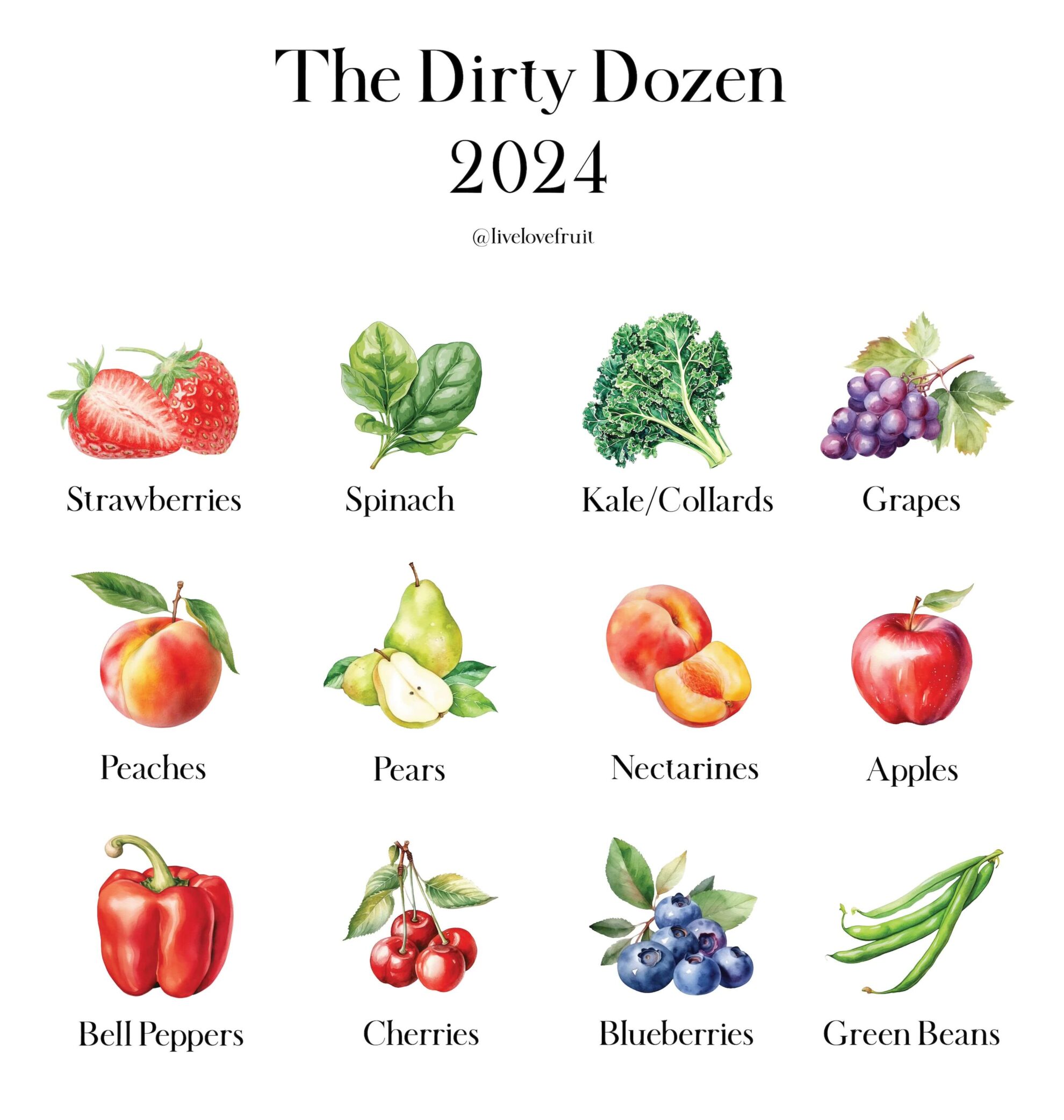
watercolour images of fruits and vegetables with title - "the dirty dozen 2024"
652 shares
  • Facebook524
  • Twitter4
  • LinkedIn

Filed Under: Food Education, Health, Pesticides Tagged With: clean fifteen, dirty dozen, pesticides

Carly Fraser

About the Author

Carly Fraser has her BSc (Hons.) Degree in Neuroscience, and is the owner and founder at Live Love Fruit. She currently lives in Winnipeg, Manitoba, with a determined life mission to help inspire and motivate individuals to critically think about what they put in their bodies and to find balance through nutrition and lifestyle. She has helped hundreds of thousands of individuals to re-connect with their bodies and learn self-love through proper eating habits and natural living. She loves to do yoga, dance, and immerse herself in nature.

View Profile

Reader Interactions

Related Posts

  • assortment of vegetables on wooden table
    My Raw Vegan Grocery List
  • Where to Buy Organic Fractionated Coconut Oil?
  • organic fruit and vegetables
    7 Reasons To Eat Organic Fruit and Vegetables
  • gardener holding bunch of radishes
    4 Holistic Health Benefits of Organic Gardening
  • Conceptual editorial illustration about industrial food production and corporate agriculture influence. Foreground: assortment of generic, unbranded processed foods (corn-based snacks, boxed cereals, soy products, seed oils, packaged baked goods) with no logos or recognizable brand names, neutral packaging only. Background: dark, moody agricultural setting with rows of industrial corn or soy fields fading into shadow, subtle sense of scale and control.
    A Complete List of Monsanto-Created Food Products You Should Avoid At All Costs
  • 5 Foods You Should Always Avoid if Pregnant
  • Sunscreen spray, hand and closeup while hiking for security from the sun and health in summer. Exercise, nature and a man with a bottle with cream for skincare and safety from sunshine for fitness
    10 Most Dangerous Sunscreen Brands of 2018 (Plus 10 Safer Alternatives)

Comments

  1. Thomas Burlington says

    Apr 20, 2018 at 10:21 am

    I am surprised you don't mention lettuce since it is very popular

    Reply
    • Carly Fraser says

      Apr 20, 2018 at 10:32 am

      Spinach is in there, but I didn't do the study, the EWG did – other lettuces may not be as high as spinach?

      Reply

Leave a Reply Cancel reply

Your email address will not be published. Required fields are marked *

Primary Sidebar

Free Ebook

Success! Please check your inbox to download your FREE eBook.

Reduce Chronic Inflammation Naturally!

The Ultimate Guide to Fight Inflammation and Restore Your Health!

21 Ways to Reduce Chronic Inflammation

Recent Posts

Glow salt lamp, dark vintage wooden background, selective focus

Fake Himalayan Salt Lamps: What You Need To Know

foods that cause gout flare ups

10 Foods That Cause Gout Flare Ups

Conceptual health image combining nutrition and human anatomy. A realistic bowl of fresh leafy greens (spinach) on a rustic wooden surface, photographed in soft natural light. To the right, a semi-transparent blue human anatomical figure with visible internal organs and circulatory system highlighted in red at the chest and upper torso.

25 Magnesium-Rich Plant Foods and Why You’re Probably Magnesium Deficient

Ultra-realistic food and wellness photography, natural daylight. Clear glass mason jar filled with a warm golden-orange homemade tonic, slightly cloudy liquid, realistic texture. Ingredients arranged naturally around the jar on a rustic wooden kitchen surface: fresh ginger root slices, fresh turmeric root, lemon halves and slices, ground cinnamon and cinnamon sticks, cayenne pepper powder, small bowl of maple syrup, unbranded glass bottle of apple cider vinegar with label turned away, and a clear glass of water. Soft steam rising gently from the drink.

This Ginger Lemon Tonic Supports Natural Detox Pathways in the Lymph, Colon, and Bladder

Fresh Medjool Dates in bowl. Grey wooden background. Close up.

10 Amazing Health Benefits of Dates (and Why You Need To Start Eating Them!)

Panic Attacks and Anxiety Linked To Low Vitamin B6 and Iron Levels

Popular Posts

bowl of cereal being sprayed with pesticide

Glyphosate in Food: Complete List of Products and Brands Filled with Dangerous Weed-Killer

Man spraying pesticides on tea plants with other side of image showing dry loose tea bags

Pesticides in Tea: Is Your Favorite Tea Contaminated with Harmful Chemicals?

Monsanto’s Harmful Chemical Glyphosate Found In 100% Of California Wines Tested

whole dandelion plant with flowers and roots on cutting board on a table

Dandelions Are Not Weeds! Top 10 Health Benefits of Dandelion

A brightly lit store shelf filled with colorful baby care bottles in pastel and vibrant shades of yellow, teal, blue, pink, and white. All bottles are unbranded with smooth, generic shapes and blank labels. The liquids inside are glossy and translucent, giving a polished retail look. The scene is sharp and high-resolution with shallow depth of field, realistic reflections, and clean packaging. Subtle unease added by one bottle faintly cracked and leaking a dark liquid, contrasting with the cheerful colors.

Johnson & Johnson Finally Admits: Our Baby Products Contain Cancer-Causing Ingredients

10 Plants That Attract Dragonflies for Mosquito Control

companion planting chart

Use This Companion Planting Chart to Help Your Garden Thrive

France Bans Neonicotinoid Pesticides

France Bans All Five Neonicotinoid Pesticides Linked to Bee Deaths

A powerful, photorealistic underwater scene showing a large whale swimming slowly through a dark blue ocean filled with floating plastic waste such as bottles, bags, fishing nets, and debris. The whale appears weakened and distressed, with plastic tangled around its body.

Whales Dying From Plastic Pollution Are a Grave Reminder to Give Up Our Addiction to Plastics

illustrated piriformis muscle showing trigger points and radiating pain

How To Get A Deep Piriformis Stretch To Get Rid of Sciatica, Hip & Lower Back Pain

RECOMMENDED

Cymbiotika B12
Cymbiotika the omega
Cymbiotika D3+K2+CoQ10
Cymbiotika coated silver

Thank you! Please check your inbox to confirm your subscription!

Want to reduce inflammation and restore your health?

Join Live Love Fruit and we'll show you how!

Footer

Stay Connected!

Follows
  • 316k Followers
  • 1.9k Followers
  • 138k Followers
  • 696 Followers
  • 11.3k Followers
  • Home
  • About
  • Start Here
  • Write For LLF
  • Contact

Any medical information published on this website is not intended as a substitute for informed medical advice and you should not take any action before consulting with a healthcare professional.
Content on Live Love Fruit may not be reproduced in any form.
Ads provided by AdThrive. Displayed ads do not constitute endorsement or recommendation by Live Love Fruit.

Copyright © 2012 - 2026 Privacy Policy | Terms of Service | Full Disclaimer | Affiliate Disclosure

652 shares
  • 524
  • 4