

It seems Monsanto’s toxic chemical glyphosate has now found its way into wine. It isn’t surprising, however, seeing as how grapes are pesticide and herbicide-laden.
Glyphosate has been showing up in foods both directly sprayed, and even foods that haven’t been sprayed, such as organic produce. It is the active ingredient in Monsanto’s Roundup herbicide, and has been used since 1974.
Recent research has suggested that glyphosate will “likely remain the most widely applied [herbicide] worldwide for years to come, and interest will grow in quantifying ecological and human health impacts.” The study showed that in 2014, farmers sprayed enough glyphosate to apply 0.8 pounds of the chemical to every acre of cultivated cropland in the U.S.
100 Percent of Wine Tested Contained Glyphosate
A supporter of Moms Across America went ahead and sent 10 different wine samples, from large and small vineyards, to Microbe Infotech Lab of St. Louis. What they found was shocking. The active ingredient in Monsanto’s Roundup weedkiller, glyphosate, tested positive in both conventional, and organic wines (although organic wines had significantly lower levels).
The test results showed that all 10 samples tested positive for glyphosate.
- The highest level detected: 18.74 ppb in a 2013 Cabernet Sauvignon from a conventional vineyard—28 times higher than other samples.
- The lowest: 0.659 ppb in a 2013 Syrah from a biodynamic organic vineyard that had reportedly never been sprayed.
All wines were sourced from California’s North Coast region (including Napa, Sonoma, and Mendocino counties) and tested between 2015–2016.
The wine brands tested included:
- Gallo
- Beringer
- Mondavi
- Barefoot
- Sutter Home
New Study Reveals Similar Results
This isn’t the only study that has revealed toxic weedkiller in alcoholic beverages. A new study released in March of 2019 confirmed that beer and wine are not safe from the cancer-causing weedkiller.
To explore how much Roundup the average person drinks, the U.S. PIRG tested 15 beers and 5 wines for glyphosate, the weedkiller’s active ingredient. Of the 20 samples tested, all but ONE contained glyphosate, and 3 out of 4 organic beers and wines contained glyphosate (likely caused by pesticide drift, shared equipment, or water contamination).
Brands with the highest concentration of glyphosate were as follows:
Top wines with glyphosate detected:
- Sutter Home Merlot: 51.4 ppb
- Beringer Founders Estates Moscato: 42.6 ppb
- Barefoot Cabernet Sauvignon: 36.3 ppb
Top beers with glyphosate:
- Tsingtao Beer: 49.7 ppb
- Coors Light: 31.1 ppb
- Miller Lite: 29.8 ppb
- Budweiser: 27 ppb
- Corona Extra: 25.1 ppb
- Heineken: 20.9 ppb
- Guinness Draught: 20.3 ppb
Other brands also came up positive for glyphosate, but at lower levels.
Health Concerns Over Glyphosate
Exposure to glyphosate at doses nearing the 0.100 ppb mark completely destroy beneficial gut bacteria, and exposures higher than that can cause breast cancer, destroy nerve cells, and damage the kidneys and liver. It can also cause miscarriages, as it destroys the placenta in pregnant and fertile women.
Since 1974, America has used over 1.8 million tons of glyphosate, with over 9.4 million tons having been sprayed on crops worldwide.
The World Health Organization finally declared that glyphosate is “probably carcinogenic to humans” in their International Agency for Research on Cancer in March 2015. That isn’t to say that Monsanto necessarily agrees, however, as they have been actively trying to fight this claim since then.
A simple Google Scholar search on glyphosate reveals its effects on health:
- stimulates the growth of human breast cancer cells
- chronic inflammation
- leaky gut
- endocrine-disrupting effects
- cell death
- neurotoxic to brain cells
- reproductive problems
- oxidative damage
- modifies sex hormone balance
- birth defects
- wipes out beneficial gut bacteria
How Does Glyphosate End Up In Wine?
Wine comes from grapes. Grapes are heavily treated with herbicides like Roundup.
Glyphosate enters plants through the soil and roots, moving systemically into the stems, leaves, and fruit. That means it’s embedded in the cells and fluid of the grape itself.
Even if a vineyard switches to organic, glyphosate can linger in soil for 10–20 years, slowly taken up by the vines. It also drifts easily from neighboring fields, contaminates water supplies, and settles in the air and dust.
Other Common Crops Sprayed with Glyphosate
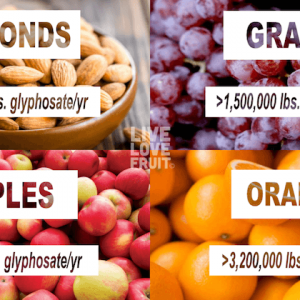
It’s not just wine grapes. A 2015 EPA memo showed glyphosate is sprayed in massive quantities on:
- Almonds
- Corn
- Oranges
- Sorghum
- Soy
- Sugar beets
- Sunflowers
- Wheat
- Cotton
Each of these crops receives over a million pounds of glyphosate annually in the U.S.
Cotton (used in clothing and hygiene products) gets a whopping 18.4 million pounds each year. So glyphosate isn’t just in your wine—it’s in your crackers, your tampons, and your t-shirt.
It’s Not Just Glyphosate We Should Worry About
Glyphosate is harmful, yes. But the co-formulants in Roundup, additives used to boost absorption, may be even more toxic.
These so-called “inert ingredients” are usually kept confidential, but studies show they:
- Act as endocrine disruptors
- Are 1,000x more toxic than glyphosate alone
- Accumulate in body tissues
- Interfere with hormone function at ultra-low levels
According to a study published in the International Journal of Environmental Research and Public Health:
“Co-formulants, generally classified as inert and kept confidential, act as endocrine-disrupting chemicals at levels hundreds of times lower than the declared active ingredient.”
Which means: even low-level Roundup exposure could be messing with your hormones, without you ever knowing it.
New Danger: Diquat, Glyphosate’s Toxic Replacement?
As pressure mounts to ban glyphosate, the industry is turning to new chemicals. One of the most common is diquat, an herbicide already banned in the EU and UK, but still widely used in North America.
Unfortunately, diquat may be even worse.
A 2025 study published in Frontiers in Pharmacology found diquat:
- Destroys gut lining proteins (ZO-1 and occludin)
- Kills beneficial gut microbes
- Causes systemic inflammation
- Leads to multi-organ damage, including the liver, kidneys, and lungs
The study concluded that diquat exposure may be more dangerous than glyphosate, especially over time. It’s already being used in U.S. vineyards.
Some Good News: Napa Green Bans Glyphosate
In response to mounting concerns, the Napa Green certification program recently announced a full glyphosate ban across its vineyards by January 2026. Synthetic herbicides will be banned entirely by January 2028.
Napa Green members are shifting toward:
- Mechanical weed removal
- Livestock grazing
- Cover cropping
- Biological pest control
It’s a huge step in the right direction. But until more vineyards follow suit, chemical residue will remain a serious risk.
What You Can Do to Protect Yourself
While we can’t eliminate glyphosate from the food chain overnight, we can make smarter choices:
1. Choose Organic Wine
It’s not glyphosate-free, but it’s better. Organic vineyards aren’t allowed to use Roundup, so any contamination is likely from drift, not direct application.
2. Look for Napa Green Certification
Napa Green-certified wines will soon be 100% glyphosate- and herbicide-free. This is one of the strictest programs in the U.S.
3. Ask Questions
Reach out to vineyards. Ask how they manage weeds and pests. Many small producers are happy to share their methods and proud to offer chemical-free wine.
4. Support Local or Biodynamic Wines
Smaller vineyards often rely on traditional, low-impact growing methods. Look for biodynamic certification (like Demeter), which goes beyond organic.
5. Push for Transparency
Support policies that require herbicide testing and labeling. We deserve to know what’s in our food and drink.
Table: Snapshot Summary at a Glance
| Topic | What’s New (2024–25) |
|---|---|
| Glyphosate in wine | Still present, even in sustainable vineyards, due to drift and soil legacy. |
| Regulatory & certification | Napa Green ban on synthetic herbicides by 2026–28. |
| Diquat dangers | 200× more toxic than glyphosate, long-term organ/gut damage, possible neurotoxicity |
| Health Risks | Gut barrier breakdown, endocrine disruption, cancer, neurodegeneration with chronic low-dose exposure |
| Consumer steps | Opt for organic or Napa Green; support chemical-free weed control; speak up with labels and messages |
Final Thoughts
Glyphosate has been found in every California wine tested, conventional and organic alike. And while some vineyards are moving toward safer methods, many still rely on chemical herbicides that contaminate the soil, the grapes, and ultimately, the wine.
The bigger picture? These toxins aren’t just in wine, they’re in our food, water, clothing, and homes. And now, with glyphosate being phased out, we’re facing new chemicals like diquat that may be even worse.
But knowledge is power. The more we know, the better we can choose. Support vineyards that care. Buy consciously. Spread the word. Because when enough of us raise our voices, and our glasses, we can demand change.




I am shocked but not surprised. Great has no limits and has no concern for the future of our globe.
Okay, so I’ve worked for both Mondavi and Beringer and here are my thoughts. This article is not factually accurate. They only tested 10 wines, which is not scientifically significant to make such a scary claim. Further, they say there were Organic and Bio Dynamic wines tested, but none of the six brands listed sell such a wine (so where was that data acquired)? And finally, they say the wines all came from the Northern California appelations, but all six of these wines are “California” or “USA” Appelated and are all sourced from the Central Valley (Lodi or Modesto Counties). So what’s the truth here? I can tell you this – the article is leaving out or making up much of their reporting…
Hey Seth – I am a very busy person, and when there are over 400 comments to respond to, it takes me awhile to get to ones like yours. This is not the only study done on pesticides in wine/beer. Here is a more recent one (which I reference in this article): https://livelovefruit.com/glyphosate-in-beer-and-wine/
What do you do to avoid as much exposure as possible or to counteract the effects?
Please include a discussion of the components of the hemp plant if you can
I would say consume as much organic foods as you can! While it may still get contaminated via airways and waterways, it will still contain the lowest amounts. Growing your own is also a great alternative.
Roundup goes by another name: MiracleGro. It’s being sold everywhere for home gardeners. Pay attention folks!