
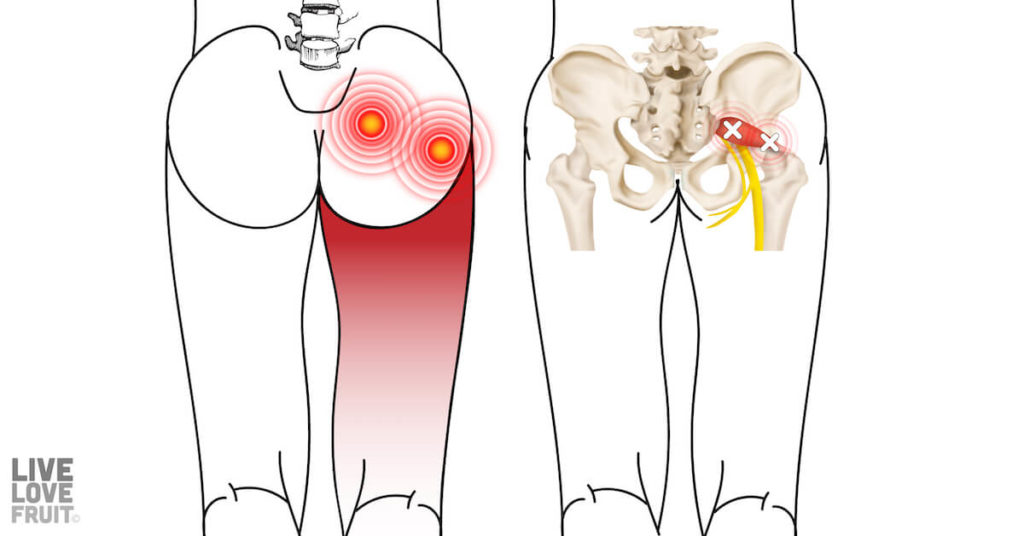
Many people suffer from lower back pain that spreads downward to the limbs and feet. This can often be alleviated by doing a deep piriformis stretch – a stretch that releases tight piriformis muscles and relaxes the sciatic nerve.
Constriction of the piriformis muscle can irritate the sciatic nerve because they lay in close proximity to each other. By irritating the sciatic nerve, the result is pain (either in the lower back or thigh), numbness and tingling along the back of the leg and into the foot.
What Is the Piriformis?
The piriformis muscle is a small muscle located deep in the buttock, behind the gluteus maximus. It connects the spine to the top of the femur and allows incredible flexibility in the hip region (it’s the main muscle that allows for outward movement of the hip, upper leg, and foot from the body).
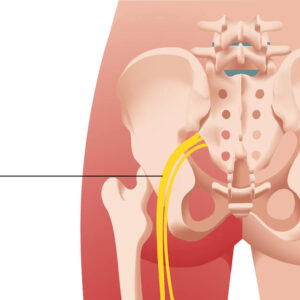
The sciatic nerve passes underneath this muscle on its route to the posterior thigh. However, in some individuals, the sciatic nerve can actually pass right through the muscle, leading to sciatica symptoms caused by a condition known as piriformis syndrome.
Unfortunately, for a lot of individuals, their sciatic nerve passes through the piriformis muscle, leaving them with pain that just won’t go away (as well as poor mobility and balance).
Causes of Piriformis Syndrome
The exact causes of piriformis syndrome are unknown. The truth is, is that many medical professionals can’t determine a cause, so they cannot really diagnose it. Even with modern imaging techniques, the piriformis is difficult to identify.
Lower back pain caused by an impinged piriformis muscle accounts for 6-8% of those experiencing back pain (1).
Suspected causes of piriformis syndrome include (2):
– Tightening of the muscle, in response to injury or spasm
– Swelling of the piriformis muscle, due to injury or spasm
– Irritation in the piriformis muscle itself
– Irritation of a nearby structure such as the sacroiliac joint or hip
– Bleeding in the area of the piriformis muscle
Any one of the above can affect the piriformis muscle, as well as the adjacent sciatic nerve.
Also, a misaligned or inflamed piriformis can cause difficulty and pain while sitting and when changing positions (from sitting to standing). I actually stretched too far in a yoga pose once, and irritated my piriformis muscle – this took about 1-2 years to fully heal. Whenever I sat down or went from sitting to standing, I experienced major pain. While it was a bit of a pain in the butt (pardon the bun), I just stuck with stretching and trigger point release and eventually, it went away.
10 Deep Piriformis Stretches
This piriformis stretch guide is great for alleviating pain and a triggered sciatic nerve.
It is important to note, too, that over-stretching can actually make the condition worse. Light, gentle stretching is best. “No pain, no gain” does NOT apply here. I over-stretched my piriformis and that’s what made it inflamed for 1-2 years (because I was still doing yoga daily, and over-doing it in stretches).
Make sure you warm up your muscles before you stretch because you can create a different injury. To warm up, simply walk or march in place or climb up and down a flight of stairs slowly for a few minutes before stretching.
Exercising and stretching the piriformis is well worth it – try it now with these 10 deep piriformis stretches:
1. Supine Piriformis Stretch
1. Lie on your back with your legs flat.
2. Pull the affected leg toward the chest, holding the knee with the hand on the same side of the body and grabbing the ankle with the other hand.
3. Pull the knee towards the opposite shoulder until stretch is felt.
4. Hold for 30 seconds, then slowly return to starting position.
There are many variations of this piriformis stretch, but here is a good video to demonstrate:
2. Standing Piriformis Stretch
1. If you have trouble balancing, stand with your back against a wall, and walk your feet forward 24 inches. Position your knees over your ankles, then lower your hips 45 degrees toward the floor.
2. Lift your right foot off the ground and place the outside of your right ankle on your left knee.
3. Lean forward and lower your chest toward your knees while keeping your back straight.
4. Stop when you feel the glute stretch.
5. Hold for 30-60 seconds, then switch legs and do the same.
3. Outer Hip Piriformis Stretch
1. Lie on your back and bend the right knee.
2. Use the left hand to pull the knee over to the left side. Keep your back on the ground, and as you do so, you should feel the stretch in the hip and buttocks.
3. Hold for 20-30 seconds, and repeat on the other side.
4. Long Adductor (Groin) Stretch
1. Sitting on the floor, stretch your legs straight out, as far apart as you can.
2. Tilt your upper body slightly forward at the hips and place your hands next to each other on the floor.
3. Lean forward and drop your elbows to the floor if you can. You will feel the pelvis stretching.
4. Hold for 10-20 seconds, and release.
5. Short Adductor (Inner Thigh) Stretch
1. For this exercise, sit on the floor and put the soles of your feet together.
2. Use your elbows to apply downward pressure to your knees to increase the stretch.
3. You should feel the stretch on the inner thighs. For a deeper stretch, bend your upper torso forward with a straight back.
4. Hold for 30 seconds, release, and flutter your legs in the same position for 30 seconds.
6. Side-Lying Clam Exercise
1. Lay on your side with the hip that needs help on top.
2. Bend your knees and position them forward so that your feet are in line with your spine. 3. Make sure your top hip is directly on top of the other and your back is straight.
4. Keeping your ankles together, raise the top knee away from the bottom one. Do not move your back or tilt your pelvis while doing so, otherwise, the movement is not coming from your hip.
5. Slowly return the knee to the starting position. Repeat 15 times.
7. Hip Extension Exercise
1. Position yourself on all fours with your shoulders directly over your hands. Shift your weight a little off the leg to be worked.
2. Keeping the knee bent, raise the knee off the floor so that the sole of the foot moves towards the ceiling.
3. Slowly lower the leg, almost back to the starting position and repeat 15 times.
8. Supine Piriformis Side Stretch
1. Lie on the floor with the legs flat, and raise the affected leg by placing that foot on the floor outside the opposite knee.
2. Pull the knee of the bent leg directly across the midline of the body using the opposite hand or towel until a stretch is felt. Do not force anything and be gentle.
3. Hold the piriformis stretch for 30 seconds, then return to starting position and switch legs.
4. Aim for a total of 3 repetitions.
9. Buttocks Stretch for the Piriformis Muscle
1. Laying with your stomach on the ground, place the affected foot across and underneath the trunk of the body so that the affected knee is on the outside.
2. Extend the non-affected leg straight back behind the body and keep the pelvis straight. 3. Keeping the affected leg in place, move your hips back toward the floor and lean forward on the forearms until a deep stretch it felt.
4. Hold for 30 seconds to get a deep piriformis stretch, and then slowly return to starting position. Aim for a total of 3 stretches.
10. Seated Stretch
1. In a seated position, cross your right leg over your left knee.
2. Bend slightly forward, making sure to keep your back straight.
3. Hold for 3-60 seconds and repeat on the other side.
Trigger Points and The Piriformis Muscle
There are many other natural and highly effective remedies for sciatic nerve pain. Trigger point therapy is one of them, and truly one of the best.
According to Myofascial Pain and Dysfunction: The Trigger Point Manual, written by doctors Janet Travell and David Simons, myofascial trigger points (tiny knot contractions) in overworked gluteus minimus and piriformis muscles in the buttocks are the main cause of sciatica and all the symptoms that come with it.
Picking up a copy of the book, or even following instruction in the video below can help release these knot contractions.







Carly,
Do you recommend using an inversion table? I've got one and found it relieves spinal stenosis but does strain lower back muscles. Guess that one should do some of these exercises along with using the inversion table.
Royce Jordan Atlanta Ga.
Inversion tables are great! I wish I could get my hands on one.
You need to look at the instructions on this page. In the first stretch, step 3 reads, "Pull the knee towards the opposite ankle until stretch is felt." Opposite ankle? I was confused by this, until I watched the video where the woman demonstrating says "the opposite shoulder". Just sayin'…
Thanks Don! That was a typo! Changed now.
Thank you, thank you, thank you! I am a teacher and have been xperiencing some major issues the past two weeks. Standing has been really painful, but so has sitting. I had a deep tissue massage that released some of the muscles, but I can't afford to keep going every three or four days. These exercises and the fact that they were shared on FB will be a Godsend. I'm going to order the massage stick. I am grateful.
I hope they help out well! 🙂
I have seen four doctors here in Vancouver BC including VGH & not one could diagnose my problem… Through 'trial & error' I pin-pointed where the roots of my problem was & how to cure it… I had excruciating pain for three months… felt on many occasion very sick because of all that pain… Hot water heavy jets & acupunture plus taking L- Glutamine (Natural muscle relaxant), did the trick… I am now totally without pain.
L-Glutamine! I have heard of that actually, and should be taking that for my own shoulder injury, thanks for the reminder 🙂
L-Glutamine is an incredible nutrient!
I've taken it for years and have had NO muscle pain, for instance, after heavy work-outs. SWANSON makes a great powder at a reasonable price. Its kind of sweet and I put one scoop (comes with it) in my morning smoothy.
ALSO for proper muscle function, don't forget MAGNESIUM…remember, the heart is a muscle! There are many Mgs out there, (bypass Mg Oxide = the cheapest, but also least absorbed); for me the "Mg Orotate" works best!
Right on! Yes, I currently take magnesium because I know our food is pretty much devoid of it. I will look into ordering some L-Glutamine! 🙂
Hi inde. Thanks for the reminder about how helpful magnesium is for muscles. What dosage do you take per day? Thanks!
I take around 200-400mg of magnesium per day, at night (absorbs best at night, as with most minerals).
Where do I find the download for the book he was talking about for 99 cents?
I think it was only a limited time offer back in 2012 (as he states in the video), you could try contacting the people from the website at http://bestbackpaintips.com/
Hi, as a Myofascial Trigger Point Therapist, I thank you for getting the word out about this very common condition that is very often missed my doctors and not treated properly by many PTs. It does not look like you are aware that you are using the name of a medical text and linking it to a self care book. That should be corrected. The Trigger point therapy workbook is fantastic and people should buy it, but you are calling it "Myofascial Pain and Dysfunction: The Trigger Point Manual, written by doctors Janet Travell and David Simons," which was the medical text written by doctors. The book you refer to was NOT written by doctors, although David Simons wrote the forward. There is the NAMTPT that is a association that promotes Trigger point therapists http://www.myofascialtherapy.org/. There is a directory and information there.
So many people suffer with the referred pain caused by trigger points because too few medical practionioners are aware of the CAUSE of their pain. I see it EVERY DAY! thank you!
Mary Jo I'm glad you pointed that out about the book and the authors. I was thinking the same exact thing. it is very misleading and one could purchase that book thinking it was from the authors Travell and Simons that were listed. it is not. Also Mary Jo thank you for posting about the myofascial release therapist association..i had gone to one years ago and she helped me tremendously she was knowledgeable and frequently referred to the medical book by Travell and Simon