• Skip to primary navigation
  • Skip to main content
  • Skip to primary sidebar
  • Skip to footer
live love fruit logo

Live Love Fruit

Eat Vibrantly. Live Vibrantly

About Start Here Work With Me

  • Home
  • Start Here
  • About
  • Health
  • Remedies
  • Recipes
  • A-Z Conditions
  • Fitness
  • Environment
  • Self Improvement
  • My LLF
  • Shop
Category: > Health > 3 Reasons To Start Putting Coconut Oil On Your Face & Skin

3 Reasons To Start Putting Coconut Oil On Your Face & Skin

Oct 6, 2017 Carly Fraser Save For Later Print

Last Updated: Nov 15, 2018

60 shares
  • Facebook54
  • Twitter
  • LinkedIn

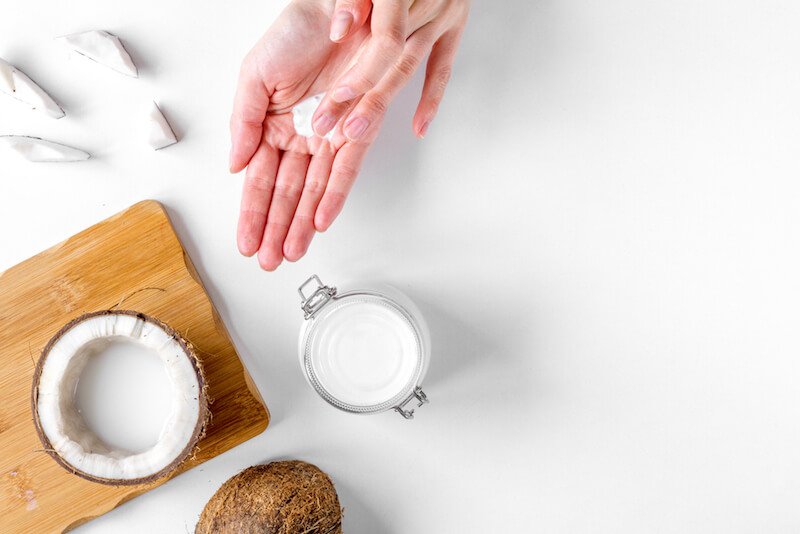
coconut oil on your face and skin

Without a solid understanding of coconut oil, some say that coconut oil carries plenty of vitamin E, which is what makes coconut oil beneficial for our skin. Not true.

No doubt vitamin E is an antioxidant that greatly benefits our skin by protecting it against oxidative stress, but every 100 grams of coconut oil contains only less than 1 milligram of this vitamin (see Nutrition Facts of Coconut Oil). That’s too tiny an amount to be able to display its antioxidative property and benefit our skin.

What’s more, for each application you can only put a dab of it on your skin to avoid saturation (which can make your skin greasy). Imagine that dab of coconut oil weighs only less than a gram, how much vitamin E is left in that meager coconut oil?

Hence, the trace amount of vitamin E is definitely not the vital component in coconut oil that benefits our skin. It is the fatty compounds in the oil that promote healthy skin. How?

1. Saturated

About 80–90 % of the fats in coconut oil are saturated. When these fatty acids are saturated, it means that they do not encourage free-radical activities, and hence, oxidation. Let me show you the evidence.

We are surrounded by gazillion invisible, omnipresent free radicals that are constantly attacking us, both internally and externally. When you expose your skin to ultra-violet (UV) ray from the sun for long hours, you get sunburn. This is because UV excites free radicals that in turn, rapidly damage the skin structure and slow the production of new cells to replace dead cells.

But fortunately, when you apply multiple layers of coconut oil to your skin, you can protect yourself from sunburn. I’ve done that. After cycling under the hot scorching sun for 4 hours when I visited Taiwan during its summer few years back, the exposed skin on the back of my neck and both my arms looked perfectly fine except for a little tanned. No burning sensation or anything. It just felt normal.

See? That’s the power of saturated fat from coconut oil. But do take note, not all saturated fats work the same way as those in coconut oil. Most of the saturated fats in coconut oil belong to the medium-chain group, which leads to the next reason why coconut oil benefits our skin.

2. Medium-Chain

When you rub pork lard, animal fats or most other vegetable oils on your skin, you would have found that they don’t penetrate your skin that well. This is because they all belong to the long-chain group.

Medium-chain fatty acids that constitute 50–64 % of coconut oil, on the contrary, are smaller in size and so they can easily penetrate our skin. How does that benefit us?

Do you know our skin is constantly shedding dead cells to provide space for new cells?

Between 30,000 and 40,000 skin cells die and are shed every hour on an average person. If we don’t get those cells replaced in time, our skin will sag and wrinkle.

Especially the elderly, their skin wrinkles easily because their skin has low cellular metabolism. But when they apply coconut oil to their skin, their skin improves over time as the cellular metabolism increases.

That’s because the medium-chain fatty acids in coconut oil can effortlessly diffuse into skin cells without insulin (long-chain fatty acid requires insulin), making them the perfect food for skin to build new cells and take the place of dead skin cells quickly.

But that’s only one of the many benefits of coconut oil for skin. Next, please…

3. Antimicrobial

All fatty acids in coconut oil possess antimicrobial properties. But those that defend your skin better are lauric, caprylic, capric, linoleic, stearic, palmitic, oleic and myristic acids because they exist in relatively greater amount, particularly lauric acid.

Each acid holds some unique abilities to fight off certain strains of bacteria, viruses, fungi and other harmful germs. But when Mother Nature fits them all together into one coconut, coconut oil (after extraction from the fruit) becomes unstoppable in fighting a wide range of malicious microbes such as H. pylori, chlamydia pneumoniae, influenza virus, HSV (herpes simplex virus), sarcoma virus, leukemia virus, and even HIV.

Our skin is the largest organ of our body. Every now and then thousands of harmful microorganisms would land on it trying to colonize and build their “homes”. Relying solely on our intrinsic skin oil (sebum) for skin defense may not suffice especially when we’re exposed to a very polluted and highly contaminated environment.

This is where coconut oil comes into play.

Without additional defense from coconut oil, health-detrimental viruses, bacteria or fungi may gain entry through our skin and start making waves in our body. So, never let your guard down when it comes to skin health.

Speaking of skin health, acne has become an increasing concern not just for the youth but for many adults as well nowadays. Acne flare is due partly to the over-secretion of skin oil that stimulates an overgrowth of acne bacteria. Since it can help to calm the production of skin oil and keep the acne bacterial count in check, you can try using coconut oil for treating acne. Some acne sufferers have done that and managed to gain back the flawless skin they used to have.

60 shares
  • Facebook54
  • Twitter
  • LinkedIn

Filed Under: Health, Natural Beauty Tagged With: antimicrobial, coconut oil, medium chain fatty acids, Skin care

Carly Fraser

About the Author

Carly Fraser has her BSc (Hons.) Degree in Neuroscience, and is the owner and founder at Live Love Fruit. She currently lives in Winnipeg, Manitoba, with a determined life mission to help inspire and motivate individuals to critically think about what they put in their bodies and to find balance through nutrition and lifestyle. She has helped hundreds of thousands of individuals to re-connect with their bodies and learn self-love through proper eating habits and natural living. She loves to do yoga, dance, and immerse herself in nature.

View Profile

Reader Interactions

Related Posts

  • Is Coconut Oil Good for Oily Skin on Your Face?
  • How to Choose Coconut Oil for Skin
  • refined coconut oil
    Is Refined Coconut Oil Good or Bad for Your Skin?
  • Can Coconut Oil Clog Your Pores?
  • Can Coconut Oil Give You Acne?
  • Does Coconut Oil Help Acne Scars?
  • 5 Biggest Misconceptions about Coconut Oil

Comments

  1. Patti says

    Nov 20, 2017 at 9:59 am

    Does fractionated coconut oil work the same as regular coconut oil? I bought some to use as a carrier oil and have been using it plain as face moisturizer as well. Am I missing any benefits?

    Reply
    • Carly Fraser says

      Nov 20, 2017 at 11:25 am

      Cold-pressed is the best!

      Reply

Trackbacks

  1. 5 Biggest Misconceptions about Coconut Oil says:
    Nov 29, 2018 at 4:33 pm

    […] reason coconut oil is good for skin lies with its antimicrobial effect, content of saturated fats and medium-chain fatty acids. Let me […]

    Reply

Leave a Reply Cancel reply

Your email address will not be published. Required fields are marked *

Primary Sidebar

Free Ebook

Success! Please check your inbox to download your FREE eBook.

Reduce Chronic Inflammation Naturally!

The Ultimate Guide to Fight Inflammation and Restore Your Health!

21 Ways to Reduce Chronic Inflammation

Recent Posts

Glow salt lamp, dark vintage wooden background, selective focus

Fake Himalayan Salt Lamps: What You Need To Know

foods that cause gout flare ups

10 Foods That Cause Gout Flare Ups

Conceptual health image combining nutrition and human anatomy. A realistic bowl of fresh leafy greens (spinach) on a rustic wooden surface, photographed in soft natural light. To the right, a semi-transparent blue human anatomical figure with visible internal organs and circulatory system highlighted in red at the chest and upper torso.

25 Magnesium-Rich Plant Foods and Why You’re Probably Magnesium Deficient

Ultra-realistic food and wellness photography, natural daylight. Clear glass mason jar filled with a warm golden-orange homemade tonic, slightly cloudy liquid, realistic texture. Ingredients arranged naturally around the jar on a rustic wooden kitchen surface: fresh ginger root slices, fresh turmeric root, lemon halves and slices, ground cinnamon and cinnamon sticks, cayenne pepper powder, small bowl of maple syrup, unbranded glass bottle of apple cider vinegar with label turned away, and a clear glass of water. Soft steam rising gently from the drink.

This Ginger Lemon Tonic Supports Natural Detox Pathways in the Lymph, Colon, and Bladder

Fresh Medjool Dates in bowl. Grey wooden background. Close up.

10 Amazing Health Benefits of Dates (and Why You Need To Start Eating Them!)

Panic Attacks and Anxiety Linked To Low Vitamin B6 and Iron Levels

Popular Posts

bowl of cereal being sprayed with pesticide

Glyphosate in Food: Complete List of Products and Brands Filled with Dangerous Weed-Killer

Man spraying pesticides on tea plants with other side of image showing dry loose tea bags

Pesticides in Tea: Is Your Favorite Tea Contaminated with Harmful Chemicals?

Monsanto’s Harmful Chemical Glyphosate Found In 100% Of California Wines Tested

whole dandelion plant with flowers and roots on cutting board on a table

Dandelions Are Not Weeds! Top 10 Health Benefits of Dandelion

A brightly lit store shelf filled with colorful baby care bottles in pastel and vibrant shades of yellow, teal, blue, pink, and white. All bottles are unbranded with smooth, generic shapes and blank labels. The liquids inside are glossy and translucent, giving a polished retail look. The scene is sharp and high-resolution with shallow depth of field, realistic reflections, and clean packaging. Subtle unease added by one bottle faintly cracked and leaking a dark liquid, contrasting with the cheerful colors.

Johnson & Johnson Finally Admits: Our Baby Products Contain Cancer-Causing Ingredients

10 Plants That Attract Dragonflies for Mosquito Control

companion planting chart

Use This Companion Planting Chart to Help Your Garden Thrive

France Bans Neonicotinoid Pesticides

France Bans All Five Neonicotinoid Pesticides Linked to Bee Deaths

A powerful, photorealistic underwater scene showing a large whale swimming slowly through a dark blue ocean filled with floating plastic waste such as bottles, bags, fishing nets, and debris. The whale appears weakened and distressed, with plastic tangled around its body.

Whales Dying From Plastic Pollution Are a Grave Reminder to Give Up Our Addiction to Plastics

illustrated piriformis muscle showing trigger points and radiating pain

How To Get A Deep Piriformis Stretch To Get Rid of Sciatica, Hip & Lower Back Pain

RECOMMENDED

Cymbiotika B12
Cymbiotika the omega
Cymbiotika D3+K2+CoQ10
Cymbiotika coated silver

Thank you! Please check your inbox to confirm your subscription!

Want to reduce inflammation and restore your health?

Join Live Love Fruit and we'll show you how!

Footer

Stay Connected!

Follows
  • 316k Followers
  • 1.9k Followers
  • 138k Followers
  • 696 Followers
  • 11.3k Followers
  • Home
  • About
  • Start Here
  • Write For LLF
  • Contact

Any medical information published on this website is not intended as a substitute for informed medical advice and you should not take any action before consulting with a healthcare professional.
Content on Live Love Fruit may not be reproduced in any form.
Ads provided by AdThrive. Displayed ads do not constitute endorsement or recommendation by Live Love Fruit.

Copyright © 2012 - 2026 Privacy Policy | Terms of Service | Full Disclaimer | Affiliate Disclosure

60 shares
  • 54